From Search Abandonment to Intent Recovery: What Ecommerce Brands Can Do Next

Written by Alok Patel
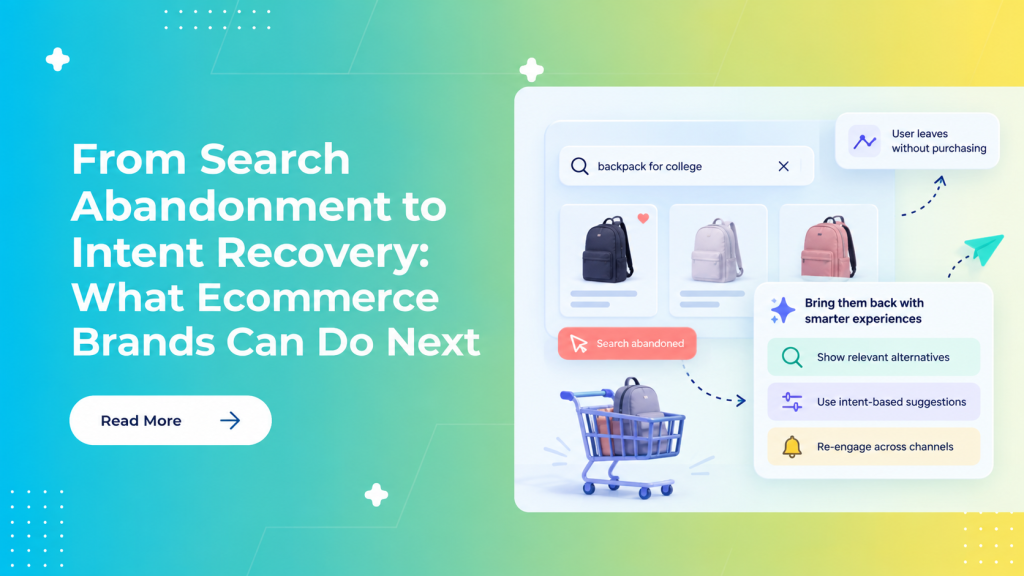
Site search analytics can show where a search journey appears to stop. They cannot, by themselves, explain why. A useful response is therefore a recovery loop: declare what counts as an in-scope search and progress event, verify the event chain, inspect the query and exposed results, route the case to relevance, catalog data, UX, or assortment, make the smallest supported change, and check both the condition that was meant to improve and the resulting behavioral pattern.
The operational definitions, measurement-trust gate, four-family taxonomy, evidence hierarchy, action contract, and complete recovery loop in this article are original editorial analysis informed by the linked research. They are not an industry standard, a universal attribution model, a product workflow, or a causal guarantee. The cited platform documentation describes particular implementations; the web-search studies support caution about interpreting behavior, not ecommerce rates or outcomes.
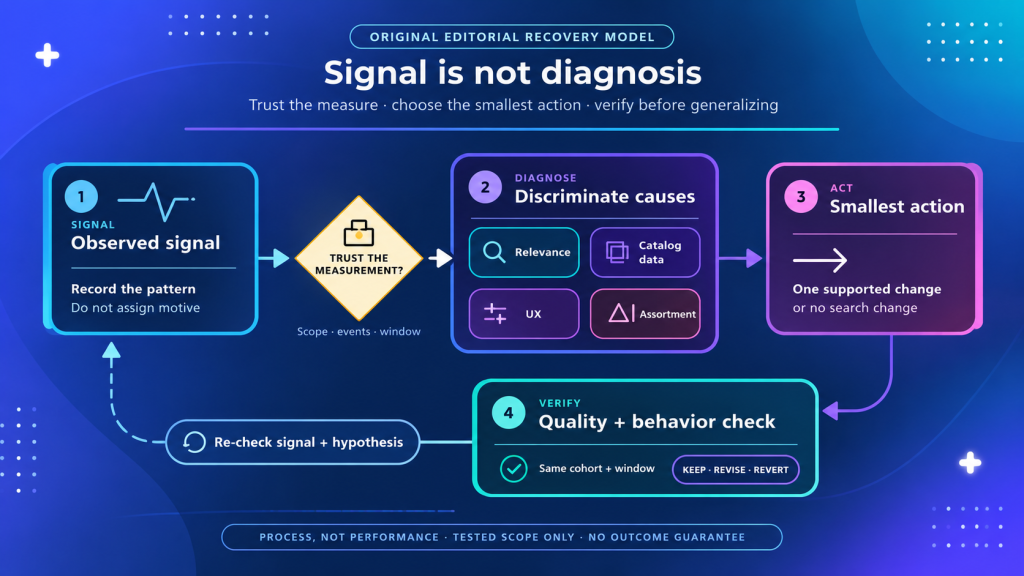
Original editorial recovery model. A signal enters diagnosis only after the measurement contract is trusted; a change is evaluated with a direct quality or correctness check plus bounded behavioral evidence.
Search abandonment is an observed signal, not a diagnosis
An exit after search, a result page without a click, a quick return after a product view, or a session without a purchase can all be measured under some implementations. None is a self-explanatory verdict. Before discussing “abandonment,” state which interaction was observed and what the instrumentation could actually see.
Declare what “drop-off” means before calculating it
For this article, observed search drop-off means an in-scope search interaction after which the chosen instrumentation records no agreed progress event within a declared observation window or before the measured session ends. This is an original operational definition, not a universal formula.
The definition needs five parts:
- the initiating event, such as a submitted query or a rendered search-results view;
- the progress events that count, such as a result selection, useful refinement, product evaluation, or another explicitly chosen state;
- the time or session boundary;
- whether predictive search, autocomplete, instant results, category search, or other surfaces are included; and
- exclusions, including test traffic, duplicate events, known consent or blocker effects, and technical failures.
That declaration matters because available reports cover different surfaces. Shopify’s Search & Discovery documentation, for example, lists searches with no results and searches with results but no clicks, and says those reports exclude predictive search (Shopify Search & Discovery analytics). GA4’s automatic site-search event depends on recognized or configured URL query parameters and records a search term; it does not automatically establish product exposure, satisfaction, or abandonment (GA4 site-search measurement). Those are platform-specific examples, not a shared denominator.
There is no evidence-backed universal search abandonment rate in the approved research. If a team calculates one, its numerator, denominator, surface coverage, and observation boundary must travel with the number. Without that contract, comparisons can mix different behaviors and different gaps in collection.
Define intent recovery as an honest next state
Here, intent recovery means helping an in-scope search interaction reach an honest next state: relevant product evaluation, a useful refinement, a visibly changed constraint, an explicitly labelled alternative, or a truthful no-match path—followed by the appropriate checks. This is also original editorial analysis.
Recovery is not synonymous with a click, a non-empty result set, a purchase, or retargeting. Returning loosely related products after silently discarding a hard constraint is not recovery. Neither is treating any downstream sale as proof that search caused the outcome. An honest no-match or a handoff to the accountable non-search owner can be the defensible result.
Establish the recovery-loop contract
Record the investigation before changing anything:
- query and search context;
- included surface, segment, and observation window;
- observed signal in neutral language;
- known measurement gaps;
- relevance, catalog-data, UX, and assortment hypotheses;
- the next check that can distinguish among them;
- the selected action or no-change/handoff decision;
- the direct quality or correctness criterion;
- the behavioral observation and guardrails;
- result, accountable owner, and retest trigger.
These fields are original practical guidance, not a required analytics schema or organization model. Their purpose is to prevent a plausible story from replacing evidence.
Gate zero: verify the measurement before interpreting behavior
A metric becomes actionable only after its scope and event path are understood. A broken event, missing result exposure, or changed surface definition can look like a relevance or UX problem. The first branch in the tree is therefore not a fix; it is a measurement-trust gate.
Fix the scope and denominator
Name the search interaction that enters the denominator. Is it a form submission, a results-page view, a predictive-search selection, or another event? Decide how reformulations, revisits, and searches across surfaces are counted. Record market or locale, device, category, result count, availability and filter context, deployment version, and the time or session boundary where available.
Also record what may be absent: predictive-search coverage, consented-out sessions, blockers, bots, employee or QA traffic, duplicate events, and failed page renders. Shopify’s documented predictive-search exclusion and GA4’s configurable URL-parameter detection illustrate why a generic label such as “all searches” can overstate scope.
Verify the compact event chain
Where implemented, connect the submitted query or results view to result exposure, result selection, product view, cart, checkout, and purchase while preserving refinements, filters, re-queries, and exits. GA4 documents these as separate ecommerce events rather than one automatic search journey (GA4 ecommerce events). Correct collection remains implementation-dependent.
Check identifier continuity, timestamps, query values, product and variant joins, result position where available, duplicate suppression, and the relevant configuration or deployment version. Google AI Commerce Search documentation provides a product-specific example of why event-to-product joins, consistent visitor identifiers, query values, catalog fields, and coverage checks matter (Google AI Commerce Search data quality). Its fields and thresholds are not universal ecommerce requirements.
A simple operating check is to run one known test journey and compare the expected events with the record. Then compare event parity across the affected segment and an unaffected segment. If the organization already has an experimentation system, an A/A check can help test assignment and measurement behavior; it does not replace implementation review or establish a universal acceptance threshold.
Stop or narrow when the measurement cannot answer the question
If result exposure is missing, do not claim to distinguish “saw results but did not click” from “results did not render.” If query, product, and session identifiers do not join, do not attribute downstream behavior to the search. If a segment spike begins with an event or scope change, repair and validate the measurement before choosing a cause family.
The gate passes only when the team can state what entered the denominator, which events and surfaces were observable, which joins were tested, and which gaps remain. Otherwise, repair, re-scope, or label the uncertainty. Do not turn partial coverage into a merchant-specific benchmark or cause.
Read each signal as a question, not a verdict
No single entry among common ecommerce search KPIs diagnoses a search problem. Use each signal to open a set of questions and identify the next discriminating evidence.
| Observed signal | Questions it raises | Minimum discriminating evidence | Possible next branch | What it does not prove |
|---|---|---|---|---|
| Zero products returned | Should an eligible product or variant exist? Was it searchable, published, available, and permitted by the active constraints? | Reproduced query and context; source facts; searchable representation; publication, availability, and filter state. | Relevance, catalog data, assortment, or measurement. | That every zero is a search failure or should be replaced with a result. |
| Results appeared; no result was clicked | Were top results relevant and understandable? Did the result cards expose the matching facts? Was the click event reliable? | Actual exposed results; human relevance judgements; card content; device, locale, and layout segment; event validation. | Relevance, UX, measurement, or no change. | Frustration, satisfaction, low intent, or failed relevance by itself. |
| Click followed by return, repeated clicks, or re-query | Did the clicked item violate a hard constraint? Did card and product facts disagree? Was the sequence exploratory? | Clicked product and variant; rank; query constraints; availability; card-to-product detail parity; declared “quick” time rule. | Relevance, catalog data, UX, downstream handoff, or unknown. | A universal bounce threshold or a search-caused failure. |
| Refinement or filter change before progress | Was this healthy exploration, a missed query constraint, unavailable facet, inconsistent attribute, or unclear interaction? | Query sequence; filter state; result-set change; attribute coverage; visible and preserved controls. | Relevance, catalog data, UX, or no change. | That filtering or reformulation is inherently friction. |
| Product view without cart or purchase | Did the product satisfy the query? Could variant, availability, offer, product page, policy, delivery, payment, comparison, or tracking explain the path? | Query-to-product judgement; event-time variant and availability; appropriate comparison segments; accountable owner input. | Search family only if mismatch is shown; otherwise handoff. | That search caused non-purchase or that purchase is a relevance label. |
| Change in one device, market, category, or release window | Did instrumentation, traffic mix, catalog coverage, locale, interaction, or configuration change? | Event parity; affected and unaffected samples; release/configuration and catalog changes; reproduced journeys. | Measurement, catalog data, UX, relevance, assortment, or unknown. | Causation from timing or segmentation alone. |
Zero products returned
A zero count is observable where the result state is instrumented. It still leaves several explanations: a retrieval or ranking miss, missing product data, an unpublished or ineligible variant, an explicit constraint, a true assortment gap, or a measurement mismatch. After confirming the actual state, readers can triage whether a no-results state is correct. That separate article owns the detailed zero-result classification; it is a reader handoff, not evidence that every zero needs a fix.
Results appeared but no result was clicked
Shopify exposes this signal in its documented reports, but click behavior is not an absolute relevance judgement. Peer-reviewed general web-search research found clicks informative but biased (click-bias study). Another web-search study described “good abandonment,” where no click or refinement could still accompany a satisfied information need (Google Research record). These studies concern web search, not ecommerce product search; they support caution, not a transferable rate or shopper interpretation.
Inspect the actual top results and ask human reviewers whether they satisfy the query. Check whether the cards make the matching facts understandable. Baymard’s public research reports cases in which ecommerce test participants could not tell why returned products were relevant when result cards omitted contextual evidence (Baymard result-card research). This supports a bounded UX hypothesis, not a universal diagnosis or outcome claim.
A click was followed by quick return, repeated clicks, or re-query
Preserve the clicked product and variant, rank where available, explicit constraints, card facts, product-page facts, and reformulation sequence. A false positive, stale availability, unclear card, downstream product-page issue, exploratory comparison, or tracking gap may all fit the same trace. Any “quick return” category needs a declared time rule; the approved evidence supplies no universal threshold.
The user refined, added, or removed filters before progress
Compare the original and refined requests, active filter state, and resulting products. Shopify documents that its filters can derive from product options, metafields, or metaobjects (Shopify Search & Discovery filters). That is a Shopify-specific example, not a universal catalog design.
The next question is whether the behavior is exploratory or corrective. A correction may indicate that a hard constraint was ignored, a relevant facet was unavailable, or product attributes were inconsistent. Exploration may be working as intended. Do not silently clear constraints or label timing alone as motive.
A product was viewed but no cart or purchase followed
First judge whether the clicked product satisfied the query. If it did not, search may warrant investigation. If it did, price, content, policy, delivery, payment, promotion, product-page interaction, comparison, delayed purchase, or tracking can remain plausible. Route the case to the accountable owner instead of changing search without query-to-product evidence.
Drop-off changed in one device, market, category, or release window
Validate event parity and sample composition, reproduce affected and unaffected journeys, and inspect configuration, catalog, availability, locale, and release changes. A coincident release or segment difference is a useful triage lead. It is not causal proof.
Diagnose the failure family with discriminating evidence
Once the measurement is trustworthy, use this original evidence hierarchy: instrumentation and scope → catalog and eligibility → explicit query and constraints → judged results → behavioral signals → causal verification. A useful search query analysis follows that order instead of treating the query text or behavior as a complete diagnosis. A behavioral metric can change confidence, but it cannot repair missing product facts or result evidence.
Google AI Commerce Search documentation separates candidate matching from relevance ranking in its own product (Google search matching and ranking). Elasticsearch documents evaluation with representative queries and manually rated results (Elasticsearch rank evaluation). These product-specific examples support layer separation and human judgement; they do not require a vendor, architecture, metric, rating scale, or threshold.
| Family | Gate question | Discriminating evidence | Safe classification language | Stop condition | Possible accountable function |
|---|---|---|---|---|---|
| Relevance | Could an eligible, adequately represented item satisfy the request, but retrieval or ranking did not? | Explicit constraints, actual exposed results, representative human judgements, false positives and negatives, hard negatives. | “Judged results show a query-to-result mismatch in the tested scope.” | Eligibility or source facts are unresolved. | Search or relevance. |
| Catalog data | Does an eligible item exist while required facts, state, or searchable representation are absent, stale, or inconsistent? | Source-to-search parity; product/variant joins; units, attributes, locale, publication, availability, and filter values. | “The required fact or state is not represented consistently for the tested item.” | No authoritative source or propagation evidence is available. | Catalog, data, or platform operations. |
| UX | Are appropriate results and facts present, but difficult to understand, compare, refine, or select? | Card context; hierarchy; labels; focus; touch targets; filter state; mobile, loading, error, and accessibility checks. | “The tested result-list interaction obscures an otherwise supportable next step.” | Relevance or catalog adequacy has not been established. | Product, design, or frontend. |
| Assortment | Does source and eligibility evidence show that no valid product can satisfy the request? | Exact product/variant, market, publication, availability, permissions, and explicit constraints. | “No eligible product satisfies the in-scope request; preserve an honest alternative or no-match path.” | Current retrieval alone is the only evidence. | Merchandising or buying, using broader commercial evidence. |
| Unknown or mixed | Is a required dependency missing, or do multiple families have separable support? | The missing discriminating check, plus independent hypotheses and their dependency order. | “The current evidence is insufficient” or “two testable mechanisms remain.” | Any attempt to blend uncertainty into a single root cause. | The owner of the earliest unresolved dependency. |
Ownership varies by organization. The function names above are examples, not a universal operating model.
Relevance — eligible products exist, but retrieval or ranking misses the request
Choose the relevance branch only after confirming that an eligible product or variant exists in the tested market and context and that required product facts are available to the search system. Compare explicit query constraints with the actual exposed results. Use representative human judgements to inspect false positives, false negatives, ordering, and hard-negative behavior.
This is a question of ecommerce search relevance within a declared set—not a claim about a vendor’s undisclosed logic. Click-through rate may be an online observation, but it cannot substitute for judged query-to-result quality.
Catalog data — the item exists, but its facts, state, or representation are missing or inconsistent
Compare authoritative product and variant facts with the searchable representation and exposed result. Inspect identifiers, parent/variant state, attributes and units, publication or listing state, availability, locale, and filter values. Separate a source correction from a propagation, indexing, or configuration repair instead of assuming one architecture.
Shopify says unlisted products do not appear in Shopify-powered search and related surfaces (Shopify product searchability). That is one platform-specific eligibility example. It does not explain why a product is absent from another search system.
UX — appropriate results exist, but presentation or interaction obstructs evaluation
Reach this branch only after relevance and catalog evidence are adequate for the tested query. Inspect whether the result card exposes the fact that makes an item relevant and whether hierarchy, controls, labels, filter visibility, focus, touch targets, loading, and error states support understanding and refinement.
Keep a product-page, offer, price, delivery, payment, or checkout issue outside this branch unless the result-list evidence supports a search UX cause. When a broader checklist is useful after this routing step, review common ecommerce search UX mistakes. That owned article is optional next reading, not evidence for this diagnosis, and its statistics and outcome claims are not used here.
Assortment — no eligible product satisfies the request
Confirm exact product and variant eligibility, market, availability, permissions, publication state, and explicit constraints before declaring a gap. Preserve a truthful no-match. Offer alternatives, adjacent categories, availability context, or a shopper-controlled constraint change only when they are explicit and relevant; do not disguise a substitute as an exact match.
Repeated query volume can justify investigation. It does not prove demand, lost revenue, or the right buying decision. Assortment decisions require commercial, supply, margin, brand, and operational evidence beyond this article.
Preserve unknown and mixed diagnoses
If instrumentation, source facts, result exposure, or human judgement is missing, record unknown and name the evidence needed next. If two mechanisms remain plausible, separate them into testable hypotheses and resolve the earliest dependency first. Uncertainty is an actionable state when it prevents an unsupported change.
Select the smallest recovery action that tests the diagnosis
A diagnosis earns a bounded action, not a bundle of generic fixes. Prefer one reversible change to the earliest evidenced layer so the result can support or challenge the hypothesis.
Write the action contract before implementation
Record the observed signal, trusted scope, diagnosis and evidence, one changed layer, affected queries or products, protected queries or segments, expected direct quality or correctness change, behavioral observation, guardrails, accountable owner, rollback condition, and retest trigger. This contract is original practical guidance, not a universal experiment specification.
Match the action to the evidenced family
- Relevance: change the narrow query interpretation, retrieval eligibility, or ranking behavior shown by judged queries. Preserve hard negatives and unaffected query classes.
- Catalog data: correct the authoritative fact or state, product-variant relationship, publication or availability value, locale value, or search/filter representation. Confirm propagation before reading behavior.
- UX: expose the missing factual discriminator or correct the evidenced result-list interaction, state, or error. Avoid a broad redesign when a narrow component is under test.
- Assortment: retain the correct no-match state and make any alternative or changed constraint explicit. Route buying or merchandising choices into their broader evidence process.
- No search cause: hand off the evidenced product-page, offer, policy, delivery, payment, or measurement issue and leave search unchanged.
These mappings are original synthesis. They are action classes, not vendor instructions or observed results.
Protect constraints and reversibility
Record the configuration or content version and a revert path. Do not silently broaden an explicit constraint, force a non-empty page, treat clicks as relevance labels, or generalize a local change to untested query classes. Before launch, a reviewer should be able to state which evidence would make the action wrong and which unaffected cases protect against regression.
If an action cannot be tied to one supported mechanism or assessed safely, collect the missing evidence or reduce its scope. Shipping several plausible fixes at once makes subsequent movement harder to interpret.
Verify recovery with quality or correctness plus behavior
Verification has two parts: test the condition the action was meant to repair, then observe behavior within the validated measurement scope. Neither half should be replaced by a commercial promise.
Check the condition the action was supposed to repair
- Relevance: inspect a representative judged-query set including the original query, reasonable variants, hard negatives, unavailable or variant cases, and unaffected query classes. Metric and judgement choices remain context-specific.
- Catalog data: verify source-to-search parity, exact product and variant state, availability, propagation, filter behavior, and affected negative cases.
- UX: check the changed task on mobile and with keyboard, focus, labels, state, error behavior, contrast, and screen-reader-relevant semantics. Confirm that result context is understandable without relying on colour or motion.
- Assortment: verify that no-match and alternative paths remain truthful, explicit, constraint-preserving, and usable. An unrelated click is not a valid match.
This family-to-check pairing is original analysis. Site search analytics can complement these direct checks; they cannot replace them.
Compare the behavioral pattern with declared guardrails
Observe only events that passed the measurement gate. Depending on the hypothesis, these may include result clicks or no-clicks, refinements, filters, product views, carts, purchases, or exits. Segment the pattern where it was first observed and compare protected queries or unaffected segments. Keep downstream measures secondary to the direct quality or correctness condition.
A movement in click or purchase behavior does not, by itself, prove relevance, causation, or intent recovery. Position, presentation, traffic mix, product offer, and measurement changes can all affect the trace.
Use controlled comparison when the decision and tooling justify it
For a causal product decision, randomized control and treatment assignment can support a stronger comparison when traffic, risk, and tooling make it feasible. General online-experiment research also shows why assignment and instrumentation failures can mislead and why A/A checks can be useful (online controlled experiment research). It is not an ecommerce search test plan.
When randomization is not feasible, use a bounded before/after, matched-segment, staged-release, or holdout observation and state its limits. The approved evidence supplies no universal duration, sample size, effect threshold, or significance rule.
Choose keep, revise, revert, or hand off
- Keep only when the direct condition improves as intended and guardrails remain acceptable within the declared scope.
- Revise when the hypothesis remains plausible but evidence or implementation is incomplete.
- Revert when the direct condition or a guardrail worsens, or the change violates explicit constraints.
- Hand off or make no search change when the evidence locates the cause elsewhere.
- Remain inconclusive when the available evidence cannot distinguish among those states.
These decision states are original operating guidance, not a universal release gate. They do not promise a ranking, conversion, revenue, or customer outcome.
| Diagnosis | Changed layer | Direct check | Behavioral observation | Guardrail | Decision limit |
|---|---|---|---|---|---|
| Relevance | Query interpretation, retrieval, or ranking | Representative human-judged results and hard negatives | Validated click, refinement, or downstream event where appropriate | Explicit constraints and unaffected query classes | Only the tested query scope |
| Catalog data | Authoritative fact, state, or search representation | Source-to-search parity and propagation | Validated search and product events after correctness is restored | Variant, locale, availability, and negative cases | Only affected products and contexts |
| UX | Result context or interaction | Task and accessibility checks | Validated selection, refinement, or backtrack behavior | Relevance, state preservation, device, and unaffected components | No inference about downstream non-search causes |
| Assortment | Honest no-match or labelled alternative path | Truthful eligibility and constraint handling | Use of clarification or explicit alternatives where measured | No disguised match or silent constraint relaxation | No demand or revenue conclusion from query frequency |
Close the loop on one observed pattern
The recovery loop becomes useful when it is completed for one bounded case, not when it becomes another dashboard or universal KPI hierarchy.
Complete one evidence record end to end
- Fix the measurement contract. Name the initiating interaction, included surfaces, qualifying progress events, observation boundary, segment, and exclusions.
- Validate the event path. Confirm result exposure, implemented events, identifiers and joins, timestamps, duplicate handling, consent or tracking effects, and configuration version.
- Record the signal without assigning motive. Describe what was observed: zero products, results without a click, click and return, re-query, filter change, downstream non-progression, or segment shift.
- Check product eligibility and source facts. Determine whether an exact valid product or variant could satisfy the request in the tested context.
- Compare the explicit request with exposed results. Preserve hard constraints and inspect result order, cards, source-to-search representation, and query sequence.
- Route the case. Select relevance, catalog data, UX, assortment, unknown, or mixed, and name the discriminating evidence.
- Choose the smallest supported action—or no search change. Change one layer where practical, protect unaffected cases, preserve a revert path, or hand off the cause.
- Define verification before the change. Pair the family-specific direct check with a behavioral observation and guardrails.
- Evaluate and decide. Keep, revise, revert, hand off, or remain inconclusive based on the declared checks.
- Report and retest narrowly. Record query, products, segment, surface, market, version, period, evidence, limitations, and retest trigger.
This sequence is original editorial analysis. It is not a validated platform workflow or guarantee.
Report the narrowest defensible result
State what changed for the tested queries, products, segment, surface, market, configuration, and period. Separate the direct quality or correctness finding from the behavioral observation, guardrails, and remaining limitations. Do not generalize one result to all search traffic, another market or device, or a commercial outcome.
Take one trustworthy site-search signal and write a one-page record with its measurement contract, competing diagnoses, discriminating evidence, smallest action or handoff, direct check, behavioral guardrail, and decision. If a field cannot be supported, name the gap and stop at the narrowest defensible state. Inconclusive and no-search-change are valid outcomes; the goal is not to manufacture certainty, a click, or a sale.
Share this article
Help others discover this content