AI-Powered Filters for Better Product Discovery

Written by Alok Patel
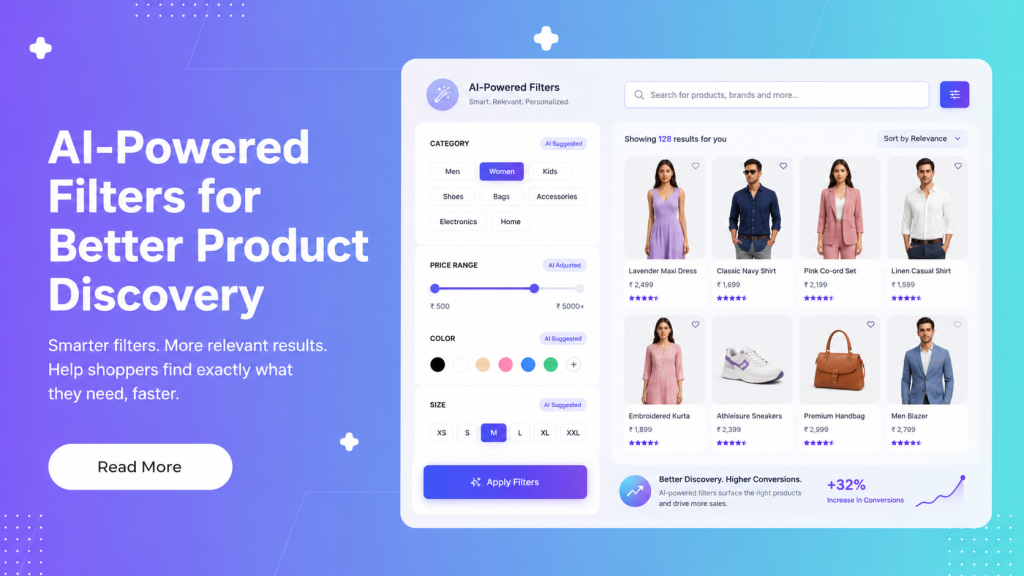
AI-powered filters help shoppers find the right products faster by making filtering feel smarter, more contextual, and less mechanical. Instead of forcing users to manually click through rigid attributes, AI can surface the most relevant filter options, rank them based on intent, and adapt the results as the shopper browses.
This matters because filters are often the difference between a shopper continuing the journey or abandoning the site. When filters are built well, they reduce friction, improve relevance, and increase conversions.
Why Filters Matter
Filters are one of the most important parts of product discovery because they let shoppers reduce a large catalog into a manageable set of options. They are especially valuable when the shopper knows part of what they want, such as size, color, price, style, brand, or material.
Traditional filters work, but they are limited because they depend on predefined attributes and manual selection. AI-powered filters improve that experience by recognizing intent, adjusting available options dynamically, and making the path to purchase shorter.
In ecommerce, that shift is a big deal. A shopper who lands on a category page with 500 products does not want to scroll endlessly. They want fast answers, fewer irrelevant options, and a clear path to the right item.
How AI Filters Work
AI-powered filters do more than show static faceted navigation. They can analyze product data, user behavior, query intent, and product relationships to decide which filter options should be shown first, which should be hidden, and which should change based on the shopper’s context.
For example, if someone searches for “wedding guest dress,” the system can prioritize occasion, fabric, color, sleeve length, and price. If someone searches for “gaming laptop,” the system can elevate RAM, GPU, screen size, processor, and battery life. The shopper sees filters that actually match the intent behind the search.
This is where AI makes the filter experience feel intuitive. Instead of forcing the customer to think like a catalog manager, the store begins to think like a shopper.
The Problem With Old Filters
Most traditional filters are built as a fixed list of attributes. That sounds useful, but it creates problems quickly when the catalog grows or when shopper behavior becomes more complex.
The first problem is overload. If every possible attribute is shown at once, the page becomes noisy and difficult to use. The second problem is irrelevance. A filter that is useful for one category may be meaningless for another. The third problem is rigidity. Traditional filters do not adjust when intent changes.
For example, a shopper looking at women’s kurtas may care about size, color, embroidery, and price. Another shopper browsing the same category may care more about occasion, sleeve type, and fabric. If the filter system treats both users the same, the experience becomes generic and slower than it should be.
Why AI-Powered Filters Improve Discovery
AI filters improve product discovery in several important ways.
They reduce decision fatigue by showing only the filters that matter most. They make shopping faster by anticipating the likely next step. They improve relevance by matching the filter structure to the shopper’s intent. They also help ecommerce teams handle large catalogs more intelligently.
This becomes especially useful in stores with hundreds or thousands of SKUs. The more products you have, the harder it is for shoppers to manually inspect them. AI-powered filters help narrow the field without overwhelming the customer.
For stores that rely heavily on mobile traffic, this matters even more. Mobile users have less patience, smaller screens, and more friction when tapping through filter sets. If filtering is clunky, they leave. If it feels smart, they keep moving.
Category-Specific Filters
One of the strongest ways to improve discovery is to create filter logic that fits the category.
Fashion needs different filter priorities than electronics. Beauty needs different filters than home décor. Grocery needs different filters than furniture. AI makes this easier because it can identify which attributes tend to matter most in each category and reorder the filter experience accordingly.
In fashion, the most useful filters are usually size, color, fit, occasion, material, sleeve type, and price. In electronics, the most important filters may be screen size, processor, battery life, brand, storage, and connectivity. In home décor, shoppers often care about color, room type, material, dimensions, and style. In beauty, shade, skin type, concern, and ingredient type matter more.
If a store uses the same filter logic everywhere, it creates unnecessary friction. AI-powered filters fix that by learning what matters in each product group.
Filter Ordering Matters
The order of filters affects how quickly shoppers find what they want. If the most important filters are buried below less relevant ones, users spend extra time scrolling and thinking. That friction can reduce engagement.
AI can reorder filters based on category behavior, shopper behavior, and query intent. For example, if users in a category always filter by size first, size should appear first. If a certain filter drives high conversion, it deserves more visibility.
This is one of the simplest but most effective improvements in product discovery. A smarter filter order makes the page feel more relevant without changing the whole design.
Multi-Select and Layered Filtering
Many shoppers do not want one filter. They want three or four.
A customer may want black items, under a certain price, in a specific size, and available for next-day delivery. If the filter system makes this difficult, the experience slows down. AI-powered filters handle these layered preferences more gracefully.
This is one of the reasons they feel better than basic filters. They allow shoppers to narrow results step by step while keeping the page responsive and understandable. They also help stores surface products that meet multiple conditions at once, which improves both relevance and conversion.
The ability to combine filters matters a lot in high-consideration categories like fashion, electronics, and furniture. The shopper is not just browsing. They are trying to eliminate bad choices quickly.
Personalization Makes Filters Smarter
AI filters become even more effective when they are personalized.
A returning shopper may see filters that reflect past behavior or preferred product types. A first-time shopper may see broader options. A mobile shopper may see a simpler set of high-impact filters. A shopper coming from a specific campaign may see filters aligned with the promoted collection.
This makes the experience feel more tailored without requiring the user to do extra work. Instead of making every shopper start from the same generic filter list, AI can adapt to the context of the visit.
That kind of personalization also helps stores avoid unnecessary clutter. If the system knows a filter is rarely used in a certain category, it can deprioritize it. If a filter is critical to conversion, it can be highlighted.
AI Filters and Search Should Work Together
Filters should never exist in isolation. They work best when connected to search.
Search helps shoppers express intent in words. Filters help them refine the results afterward. AI makes this relationship stronger by translating search queries into useful filter suggestions and adjusting the filter set as the shopper continues browsing.
For example, a user searching “office shoes for women” may be shown filters like heel height, color, material, and comfort features. Another user searching “gaming chair for back pain” may see lumbar support, adjustable height, recline angle, and weight capacity. The point is not just to show products, but to guide the shopper through a smarter discovery path.
When search and filters are aligned, the user does not need to guess how the store is organized. The store feels easier to use, and that usually leads to better conversion.
Common Problems AI Filters Solve
AI-powered filters are especially useful when stores face one or more of these issues.
One issue is too many products and too many attributes. When catalogs grow, manual filtering systems become harder to manage. AI helps organize the experience so that shoppers are not buried under options.
Another issue is poor attribute quality. Many stores have missing or inconsistent product data. AI can help identify gaps by showing which filters are underused, which products are not showing up in filtered views, and which attributes are needed more often.
A third issue is filter fatigue. If shoppers keep opening filters and closing them without applying anything, the system is probably too complicated. AI can simplify that by making the most useful filters visible first.
A fourth issue is mobile abandonment. On small screens, long filter menus are painful. AI can reduce the number of steps needed to reach a useful product set.
How to Measure Filter Performance
If you want to improve filters, you need to track the right metrics.
The first metric is filter usage rate. Are shoppers actually using the filters you built? The second is filter-to-product click-through rate. After filtering, are shoppers clicking into products more often? The third is add-to-cart rate after filter use. The fourth is conversion rate from filtered sessions.
You should also track zero-result rate and search-to-filter engagement. If shoppers search, then use filters, then abandon, that tells you something important about relevance or catalog structure. If they use filters heavily but still do not buy, the results may not be good enough.
These metrics give you a clearer picture of whether filters are helping or just taking up space.
Best Practices for AI-Powered Filters
A strong filter experience usually follows a few principles.
Keep the most useful filters at the top. Limit clutter on mobile. Use category-specific logic instead of one universal structure. Support multi-select filters for layered shopping intent. Make sure filters update fast and feel responsive. Review filter analytics regularly so the experience improves over time.
Also, do not treat filters as only a navigation tool. They are a merchandising tool. They are a conversion tool. They are part of your product discovery strategy.
If a filter helps shoppers find the right product faster, it deserves attention just like pricing, product pages, or checkout.
What This Means for Shopify Stores
For Shopify stores, AI-powered filters are one of the easiest ways to make a catalog feel more intelligent without rebuilding the entire site. Stores that use better filtering often see lower bounce rates, stronger engagement, and more conversions because shoppers can narrow down products quickly and confidently.
This is especially important for fashion, beauty, home, and electronics brands where choice overload is common. If the store has many SKUs, filter design becomes a revenue decision, not just a UX decision.
The goal is not to add more filters. The goal is to make the right filters appear at the right time for the right shopper.
Final Thought
AI-powered filters improve product discovery because they reduce friction at the exact point where many shoppers get stuck. They make large catalogs feel smaller, more relevant, and easier to navigate.
When filters are smart, shoppers do less work. When shoppers do less work, they find products faster. When they find products faster, conversions improve.
That is why AI-powered filters are becoming one of the most valuable parts of modern ecommerce discovery.
Share this article
Help others discover this content