5 Best Shopify Warranty Apps for Post Purchase CX and Retention in 2026
A customer buys a premium product, opens the box, scans a QR code, and wants one thing right away: confidence. If registration feels long, confusing, or disconnected from the purchase, the brand loses a valuable moment. Support teams know this pain too. Claims arrive through scattered channels, proo
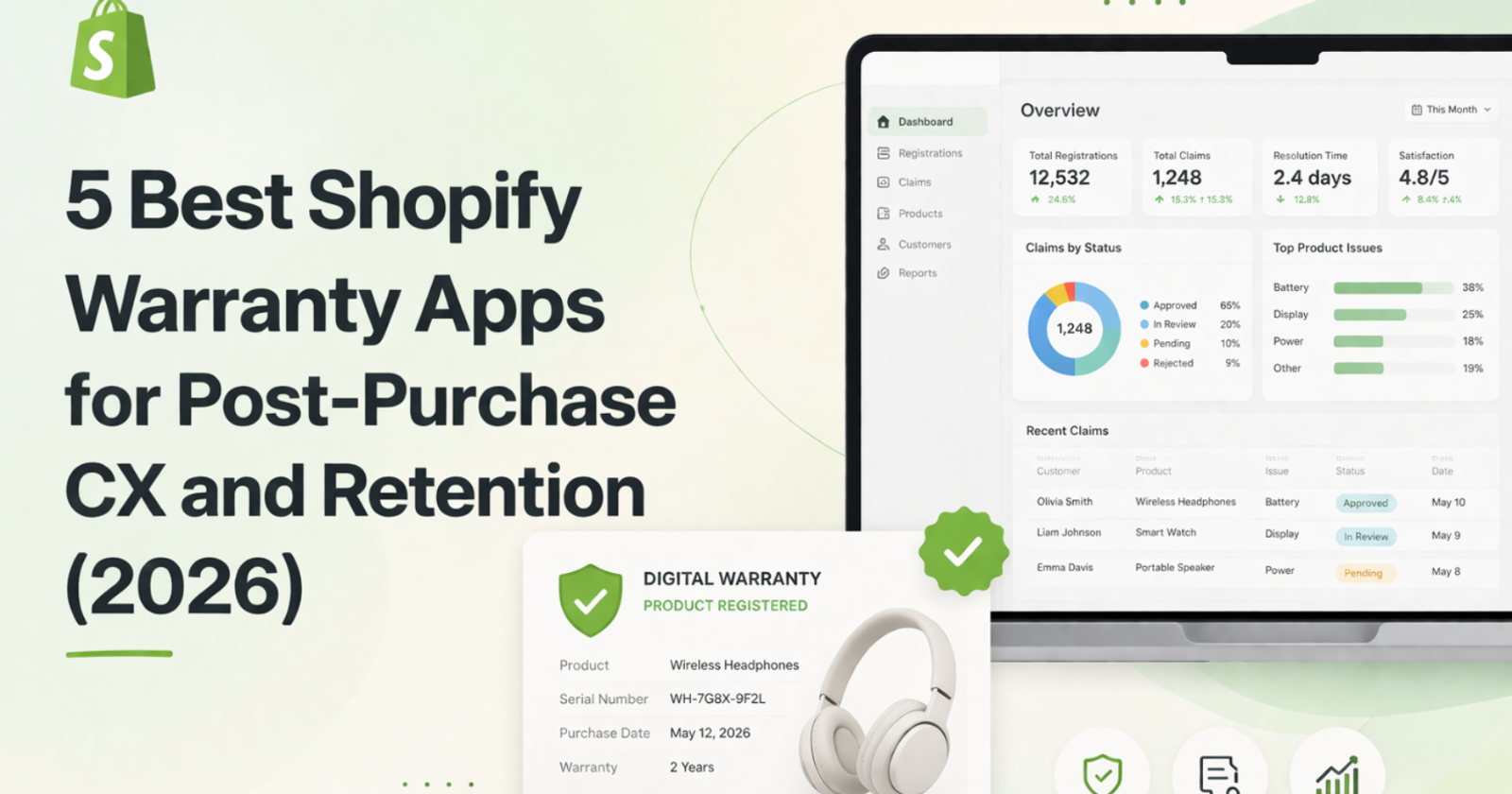
A customer buys a premium product, opens the box, scans a QR code, and wants one thing right away: confidence. If registration feels long, confusing, or disconnected from the purchase, the brand loses a valuable moment. Support teams know this pain too. Claims arrive through scattered channels, proof of purchase sits in different systems, serial numbers get checked by hand, and every delay chips away at trust. And for Shopify brands selling electronics, accessories, baby gear, home products, or fitness items, post purchase service often decides whether a first order grows into repeat revenue.
You may have landed here because your current process creates extra admin work, claim handling feels messy, product data stays fragmented, or your team wants stronger post purchase CX without adding friction for customers. You may also want richer first-party data, cleaner product ownership records, better visibility into claim trends, and fresh ways to drive loyalty, upsell opportunities, and long-term retention through registration.
So here is what you can expect from this guide. We will walk through five Shopify apps with a clear lens on customer experience, retention, claims management, warranty registration flow, serial number handling, integrations, setup, reviews, and pricing. We will also look at the practical use cases behind each option, so you can match the right app to your store, your products, and your post purchase strategy with confidence.
How Warranty Apps Help Shopify Brands?
Cleaner post purchase service. Once orders start growing, support conversations can scatter across email threads, inboxes, chat tools, and internal notes. Warranty apps bring registration details, proof of purchase, product ownership, serial data, and claim history into one flow. Customer support gets a clearer view of each case, and customers get a smoother path from registration to resolution. That creates a stronger post purchase journey and a better brand impression after the sale.
Stronger customer trust. Customers want clarity after purchase. They want quick access to coverage details, a direct registration path, and a clear claim process. A good warranty app gives them that sense of structure right away. Branded forms, digital warranty records, status updates, and self-serve portals give buyers more confidence in the product and in the company behind it. That confidence can shape future purchase decisions in a very real way.
Better first party customer data. Warranty registration gives Shopify brands a valuable chance to capture customer information tied to a specific product. This can include ownership details, serial numbers, product type, purchase channel, and service history. That data becomes useful across support, retention, and lifecycle marketing. Teams can spot who owns which product, segment customers more accurately, and plan smarter follow ups based on product ownership and service activity.
Faster claims and lower admin load. Claims often become slow when teams have to chase invoices, verify order details manually, or search through separate systems for product information. Warranty apps reduce that friction. They organize claim intake, validate serial numbers, route requests more efficiently, and track case status in one place. For support teams, this often means fewer repetitive tasks and more time for higher value customer conversations.
Useful product insights. Warranty data can reveal much more than claim counts. It can show which products generate the highest claim volume, which issues appear again and again, which channels bring stronger quality outcomes, and how quickly teams close cases. These insights help brands improve products, refine service workflows, and spot issues earlier. For growing Shopify stores, this kind of visibility can support both CX and operational decision making.
More retention and upsell opportunities. A warranty touchpoint gives brands another chance to stay connected after checkout. Registration emails, care tips, product education, extended protection offers, and relevant add ons can all fit naturally into this stage. When done well, this creates added value for the customer and new revenue opportunities for the brand. It also gives the post purchase journey a stronger role in loyalty and repeat orders.
Key Features to Look for in a Warranty App
1. Smooth registration experience. A strong app should give customers an easy way to register products through QR codes, order lookup, account area access, or branded forms. When registration feels clear and quick, completion rates improve and customer data stays more accurate.
2. Structured claims management. Look for an app that handles claim submission, proof uploads, status tracking, team workflows, and customer communication in one place. This gives support teams a cleaner process and gives customers a far better service journey after purchase.
3. Serial number and product validation. For brands selling electronics, accessories, appliances, tools, or premium goods, serial number support is a major feature. Validation, duplicate checks, and serial based lookup help verify ownership, improve claim accuracy, and strengthen product traceability.
4. Integration with your Shopify workflow. The app should connect well with Shopify orders, customer accounts, POS, fulfillment data, and key tools such as email platforms, helpdesk software, or workflow automation systems. Strong integration creates a more connected post purchase setup across support, marketing, and operations.
5. Analytics, customization, and growth features. A valuable warranty app should also give you dashboards, branded customer touchpoints, custom fields, and added revenue options such as care plans or upsells. These features help brands gain better visibility, improve customer experience, and turn warranty touchpoints into a stronger retention channel.
Best warranty registration and management apps for Shopify brands
Warranty registration and management can either sit quietly in the background or become a real part of post purchase CX. The difference usually comes from structure. When registration, claims, serial validation, customer communication, and reporting sit in one workflow, teams spend less energy chasing details and more energy resolving issues quickly. That has a direct effect on satisfaction, repeat purchase potential, and the quality of customer data a brand can use later.
Below are five apps worth considering for Shopify brands. Each one approaches the problem from a slightly different angle. Some lean further into claims and customer portals. Some lean further into serial control. One stands out more clearly for brands that want warranty operations tied closely to retention, lifecycle marketing, and broader post purchase engagement.
1. Dyrect – Warranty Registration and Claims
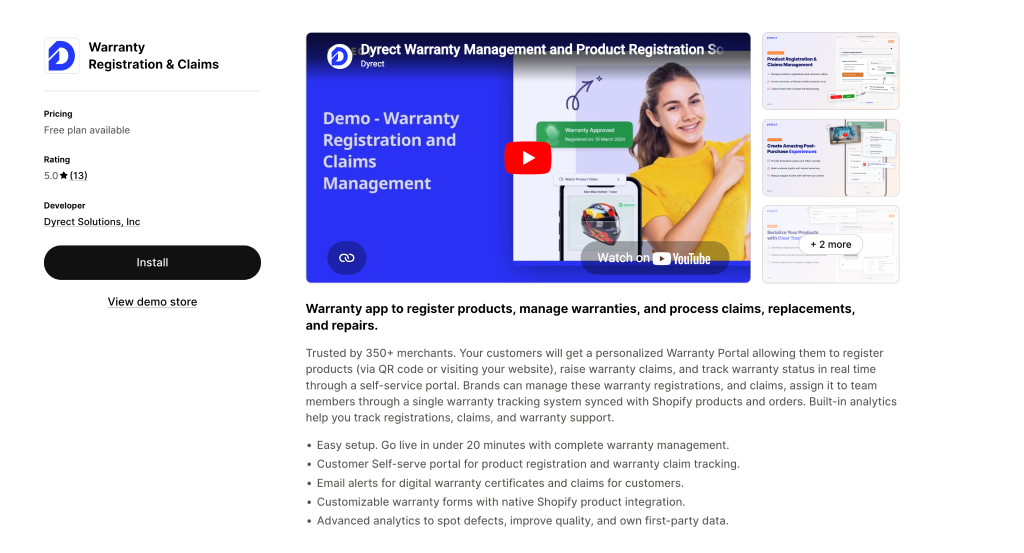
Dyrect fits brands that want warranty registration and claims to work like a connected post purchase system instead of a standalone support add on. The app covers registration, claims, repairs, replacements, digital warranty cards, QR based registration, claim tracking, and a customer self service portal. That means a buyer can move from purchase to registration to claim submission through a cleaner path, and the brand gets a structured record of ownership, issue history, and service activity.
From a CX and retention point of view, Dyrect has a wider scope than the rest of the apps in this list. It connects warranty workflows with analytics, customer engagement, and upsell opportunities. Teams can track registrations, claim flow, issue patterns, and customer activity in one dashboard, which is useful for spotting recurring product issues, service bottlenecks, and missed revenue opportunities. That matters for merchants who want warranty data to inform retention work, service planning, and future product decisions.
Another important point is integration depth. Dyrect connects with Shopify and also with tools such as Klaviyo, HubSpot, Mailchimp, Gorgias, Zendesk, and Zoho Desk. For brands that already run lifecycle marketing, support automation, or CRM workflows, that integration layer adds real operational value. Registration data can feed follow up campaigns, service communication, and segmented retention activity more smoothly than it would through a disconnected app.
Dyrect also suits omnichannel brands well. It supports QR based registration, serial number validation, and workflows that help brands capture ownership beyond a standard online order path. That is useful for brands selling through ecommerce, retail, offline events, or partner channels, especially in categories such as consumer electronics, accessories, baby gear, fitness, household products, furniture, beauty, and smart home. As of the latest Shopify App Store listing, it is rated 5.0 out of 5.
- Best for: Shopify brands that want warranty registration, claims, customer data, analytics, and post purchase marketing support in one system. It fits especially well for omnichannel merchants and brands that want warranty activity tied closely to retention and lifecycle communication.
- Pricing / plans: Free plan available. Paid plans start at $19 per month, then move to $49 and $149 per month, with credit based usage across tiers.
2. My Product Registration
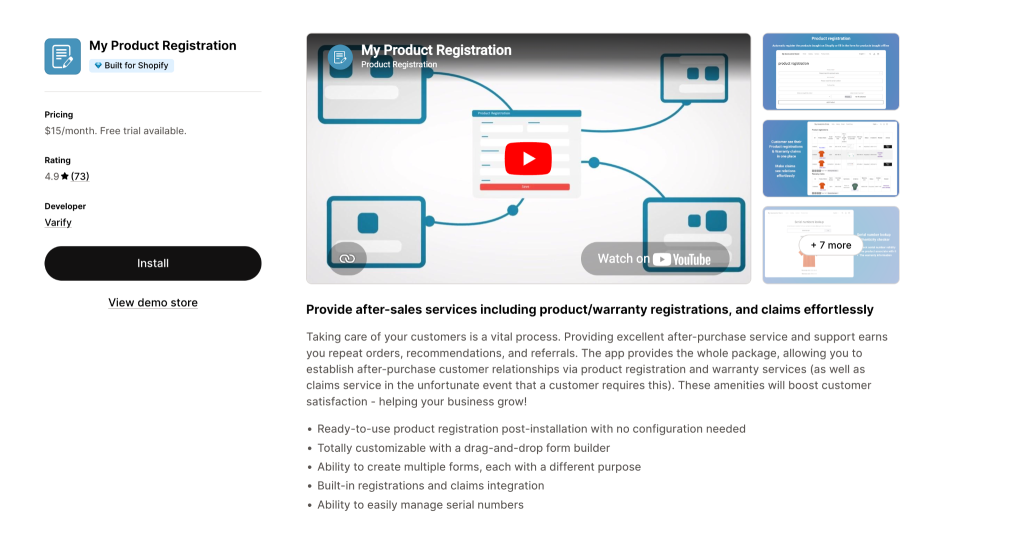
My Product Registration is a more established option for merchants that want a broad warranty and registration setup with steady operational coverage. The app supports product registration, claims, serial number management, customer portal access, multiple registration flows, email notifications, and warranty care plans. It also works with Shopify POS, customer accounts, Shopify Flow, and email tools such as Klaviyo and Mailchimp.
This app suits stores that want a structured registration and claims process with flexibility across online and in store sales. A merchant selling through ecommerce plus physical retail can use it to capture ownership records across both channels, which helps support teams verify coverage and process service requests with fewer manual checks. It also gives brands a way to stay in contact with product owners after purchase through service communication, product updates, and account based interactions.
Compared with Dyrect, the CX and retention angle here is present, though less central in the way the product is positioned publicly. The app supports those outcomes through customer data capture and ongoing support access, though the broader dashboard and revenue visibility story is less prominent.
- Best for: Merchants that want a mature registration and claims setup with serial number handling, POS support, and customer account coverage.
- Pricing / plans: $15 per month with a free trial period.
3. Propel
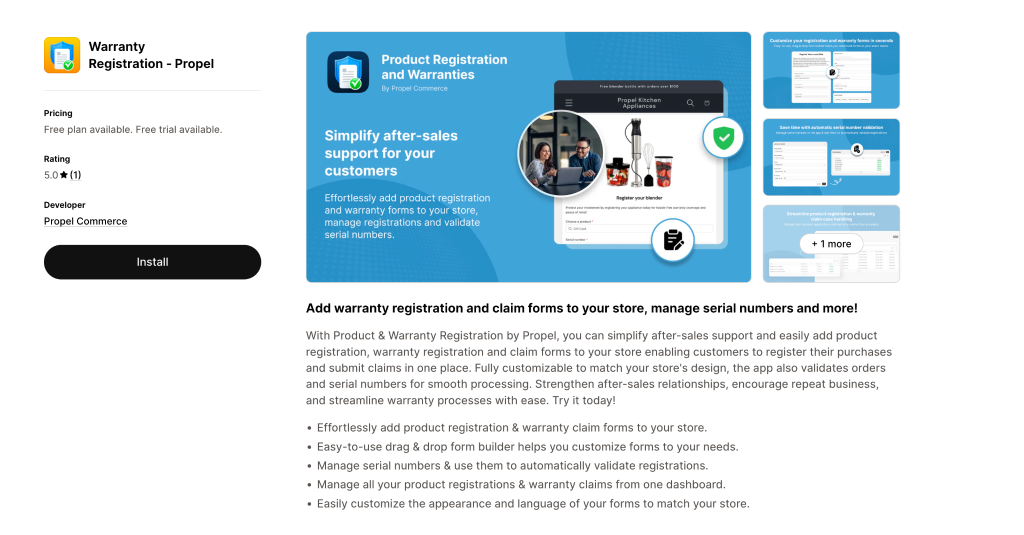
Propel is a lighter warranty registration and claims app with a simpler setup path. It includes product registration, warranty claim handling, serial number validation, a drag and drop builder, and mobile friendly customization. This gives merchants a direct way to collect registrations and claims without stepping into a broader service platform.
For smaller teams, that lighter structure can be useful. A merchant that mainly wants a branded registration flow, claim intake, and serial validation can launch quickly and manage the process from one dashboard. The app also supports after sales service in a practical way, since customers get a clearer route for registration and claims rather than relying on scattered email threads.
The reason Propel sits below Dyrect and My Product Registration in a CX and retention focused list comes down to scope. It covers the core registration and claims job well, though it has a narrower public story on analytics, omnichannel warranty strategy, and connected retention workflows.
- Best for: Smaller Shopify merchants or growing stores that want product registration, warranty claims, and serial validation with a lower monthly cost and a lighter operational setup.
- Pricing / plans: Free plan available. Paid plan starts at $9.95 per month, with an annual option as well.
4. SeriaLogic
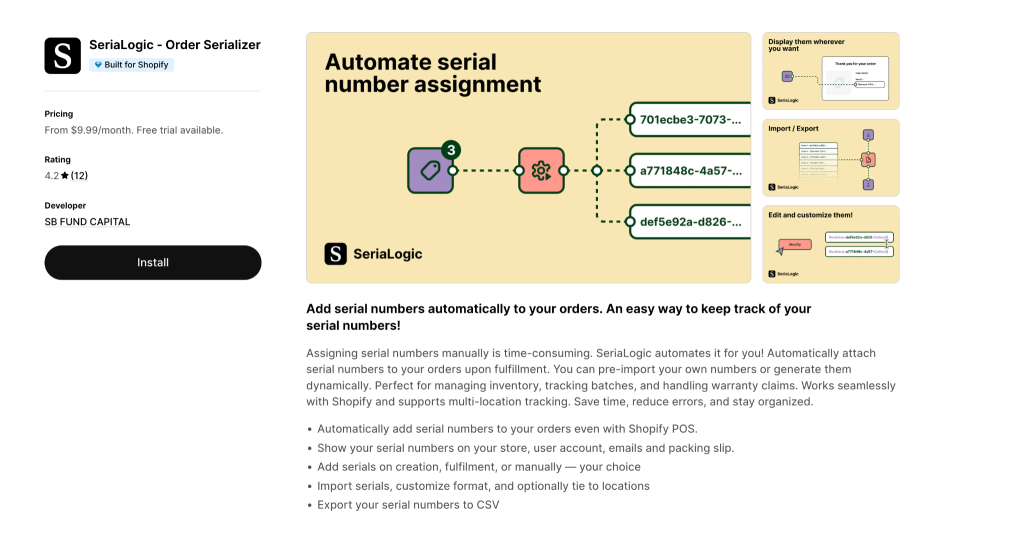
SeriaLogic comes into the conversation from a different angle. It is primarily a serial number management app, which means its value sits in product traceability, ownership validation, and cleaner warranty support infrastructure. It supports automatic serial generation, serial imports, custom serial formats, packing slip visibility, customer account visibility, multi location tracking, Shopify POS, and Shopify Flow.
For brands selling serialized products, that serial layer is often a major part of warranty management. When support teams can identify exactly which unit a customer owns, claim handling becomes far easier. Product traceability improves, fraudulent claims are easier to flag, and customer service gains a more reliable base for verification. In categories such as electronics, equipment, technical accessories, and durable goods, that matters a great deal.
SeriaLogic fits best when serial control is the core operational requirement and the merchant already has a separate path for broader customer service or marketing communication. In a retention focused comparison, it plays a narrower role than Dyrect, since it is more infrastructure led than post purchase engagement led.
- Best for: Merchants selling serialized products who need stronger serial control, warranty validation support, packing slip visibility, and multi location tracking.
- Pricing / plans: Plans start at $9.99 per month, with higher tiers at $24.99 and $49.99 plus usage based fees at larger order volume.
5. Uncap
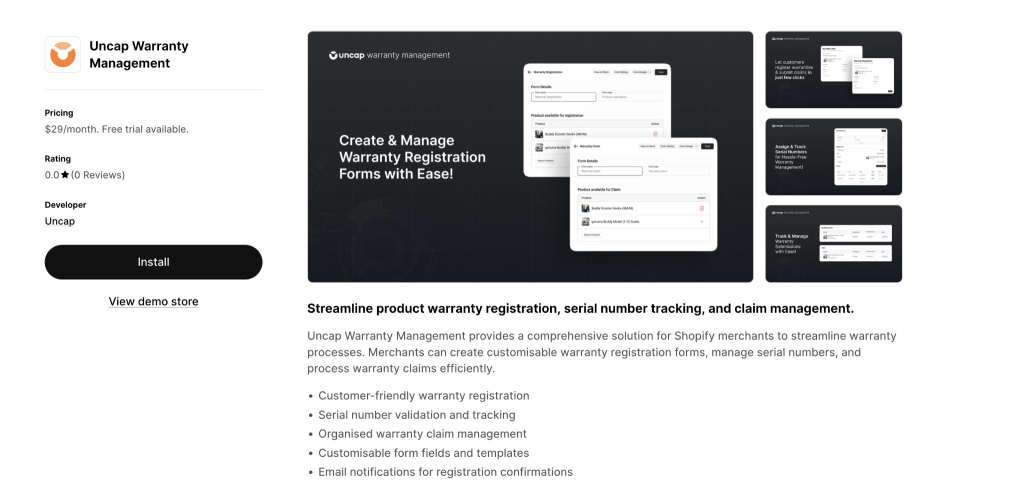
Uncap Warranty Management is a leaner option built for registration, claims, and serial validation. The app includes customizable registration fields, warranty claim management, email confirmations, serial tracking, unlimited registrations, and a claims portal. That gives merchants a straightforward path to collect registrations and route service requests through a more organized structure.
Its wider company positioning leans further into B2B, manufacturing, wholesale, industrial products, auto parts, building materials, medical equipment, and similar categories. That context gives the app a clearer place for merchants selling harder goods or operating in more operationally heavy environments. A brand in those categories may value a direct, structured registration and claims workflow without needing a broader post purchase suite.
In a CX and retention focused ranking, Uncap sits as a more limited option compared with Dyrect. The core functions are there, though the public picture is lighter on marketing integrations, retention workflows, and broader analytics.
- Best for: B2B, industrial, wholesale, or harder goods merchants that want a direct warranty registration and claims setup with serial tracking.
- Pricing / plans: $29 per month with a free trial period.
How to choose the right warranty app for your brand
The right warranty app depends on what your team needs most after purchase. For some brands, the biggest issue is scattered claims. For others, it is weak customer data, poor serial tracking, or limited visibility into service volume and product issues.
Start with your sales model. If you sell through ecommerce, retail, and offline channels, choose an app that supports omnichannel registration and serial validation. If your products move through a single online channel, a lighter setup may be enough.
Then look at your post purchase priorities. If retention, loyalty, customer data, and lifecycle marketing sit high on your list, choose an app that connects warranty workflows with analytics, self service, and marketing integrations. If your main priority is claim intake, a narrower tool can still fit well. If serial control sits at the center of your support process, choose a platform that handles serialization properly from day one.
It also helps to check four practical areas before you decide:
- Customer journey: Registration should feel easy on mobile and clear for buyers.
- Team workflow: Claims, approvals, and communication should move through one organized process.
- Integrations: The app should connect well with Shopify, support tools, and marketing platforms already in use.
- Growth fit: The app should support your current volume and still work well when registrations and claims increase.
A strong choice is usually the one that solves today’s support friction and also gives your brand better customer data for the months ahead. That is why brands with a strong CX and retention focus often lean toward a platform such as Dyrect, since it connects registration, claims, analytics, and post purchase engagement in one place.