From Search to Agents: How Product Discovery Is Evolving in Ecommerce
Product Discovery Is No Longer Human-First “For the first time in ecommerce, your primary shopper may not be a human.” Until recently, product discovery was simple: Users searched Browsed Clicked Decided Every optimization—from SEO to UX—was built around this behavior. That model is changing. Today,
Product Discovery Is No Longer Human-First
“For the first time in ecommerce, your primary shopper may not be a human.” Until recently, product discovery was simple:
- Users searched
- Browsed
- Clicked
- Decided
Every optimization—from SEO to UX—was built around this behavior. That model is changing.
Today, AI is starting to:
- Interpret what users mean
- Filter products instantly
- Recommend what to buy
So the journey is shifting from: User → Website → Purchase
To: User → AI → Decision
Which means: Product discovery is moving from user-driven interfaces to machine-driven decisions. And when machines start deciding what gets seen—
everything about how ecommerce works begins to change.
Phase 1: Keyword Search (The Original Discovery Layer)
What discovery looked like
Early ecommerce search was built on a simple rule:
Match what the user types
- Search = keyword matching
- Rankings based on titles, tags, and exact matches
- Filters used only after results appeared
If a user typed “red shoes,” the system looked for products containing those exact words.
Where it broke
This model worked in theory—but failed in real-world behavior:
- No understanding of intent
- Couldn’t handle synonyms or context
- Failed on natural queries (“shoes for a wedding”)
- Frequent zero-result searches
Users had to adapt to the system, instead of the system understanding the user.
Insight: Discovery was input-driven, not intent-driven
What mattered was how the user typed, not what they actually meant. And that limitation is what led to the next evolution.
Phase 2: AI Search (Intent Becomes the Core)
What changed
Search stopped matching words—and started understanding meaning.
- Natural language queries instead of exact keywords
- Synonym mapping (e.g., “hoodie” = “sweatshirt”)
- Behavioral ranking based on clicks and purchases
- Context-aware results (attributes, trends, usage)
The system no longer asked: “What did the user type?”
It started asking: “What does the user actually want?”
What this unlocked
- Fewer zero-result searches
- Faster path to relevant products
- Higher conversion rates from search users
Search became less of a tool—and more of a decision accelerator
But still limited. Even with AI, discovery still depended on the user:
- The user had to initiate the search
- The interface (search bar, filters) still controlled the journey
- The system reacted—it didn’t act
Key transition: From keyword matching → intent interpretation
But discovery was still human-initiated and interface-driven—
which is exactly what the next phase changes.
Phase 3: Agentic Commerce (Discovery Without Browsing)
What’s fundamentally different
Discovery is no longer a manual journey—it’s an automated process.
AI agents can:
- Interpret user goals
- Discover products across platforms
- Compare, filter, and even purchase
Users don’t browse
Agents do
New discovery flow
Instead of: User → Search → Browse → Decide
Now: User → Prompt → Agent → Decision
The effort shifts from interaction to instruction.
Key shift: Discovery becomes:
- Autonomous (agents take action)
- Continuous (always optimizing decisions)
- Machine-to-machine (systems evaluating systems)
And in this model, visibility is no longer about what users see—it’s about what agents choose
The Death of Traditional Discovery UX
This is the uncomfortable shift most brands haven’t processed yet:
The discovery experience you’ve been optimizing for may no longer be the primary one.
What becomes less important
- Category navigation
- Endless visual browsing
- Manual filters and faceted navigation
These were designed for humans exploring. But agents don’t explore—they evaluate and decide instantly.
What becomes critical
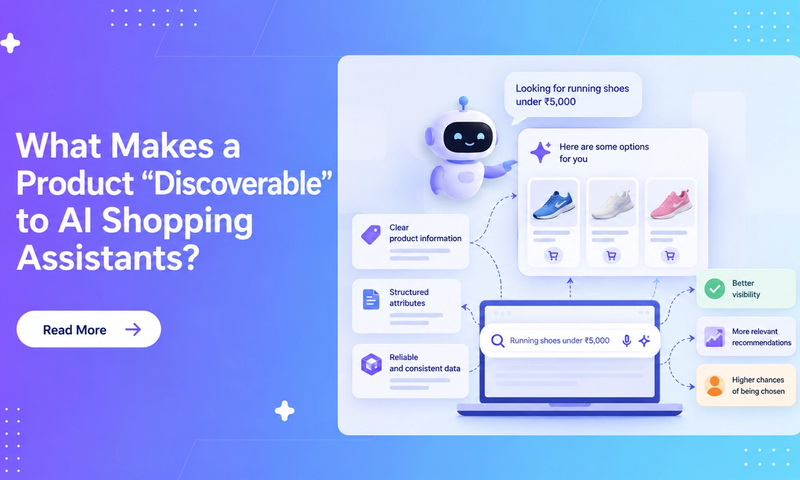
- Structured product data (attributes, variants, taxonomy)
- High-quality search relevance (intent match, not keywords)
- API-accessible, machine-readable catalogs
Because agents don’t “see” your UI—they consume your data layer
Insight: You’re no longer optimizing for users—you’re optimizing for agents
And in this shift, the competitive advantage moves from:
- Better design → to better data
- Better UX → to better decision systems
The brands that adapt to this will get chosen.
The rest won’t even get considered.
What AI Agents Actually Look For
If humans browse, compare, and get influenced—AI agents do something very different:
They evaluate and decide. Here’s what that evaluation is based on:
1. Relevance (Not Keywords)
Agents don’t match words—they match intent.
- Does this product solve the user’s need?
- Does it fit the context (budget, use case, timing)?
A product with better intent alignment will win—even if it’s not the most “popular”
2. Structured Product Data
Agents rely on clean, machine-readable information.
- Attributes (size, color, material, use case)
- Variants (clear differentiation)
- Clean taxonomy (proper categorization)
Poorly structured data = invisible to agents
3. Availability & Fulfillment
Agents optimize for outcomes—not just options.
- Is the product in stock?
- How fast can it be delivered?
- Is it reliable to purchase now?
Products with fulfillment certainty get prioritized
4. Pricing & Value Signals
Agents compare value instantly across options.
- Discounts and offers
- Bundles and pricing logic
- Competitive positioning
It’s not about the cheapest product—it’s about the best value match
Insight: Agents don’t browse—they evaluate
And that means your products aren’t competing for attention anymore—they’re competing on data quality, relevance, and decision readiness
The New Discovery Stack
As discovery shifts from humans to agents, the architecture behind it needs to evolve.
It’s no longer about isolated features like “search” or “filters”—
it’s about a connected, intelligent discovery stack.
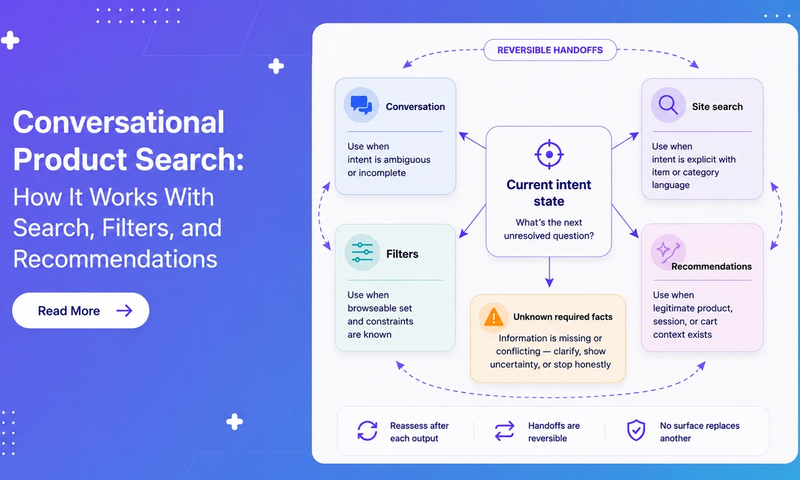
Layer 1: Intent Capture
This is where discovery begins.
- AI-powered search
- Natural language understanding
- Query interpretation beyond keywords
The goal: Understand what the user actually wants
Layer 2: Decision Layer
This is where most value is created—and where most stores fail.
- Dynamic ranking logic
- Merchandising controls (boost, bury, pin)
- Inventory-aware prioritization
The goal: Decide what should be shown—and in what order
Layer 3: Discovery Output
This is what gets surfaced to users (or agents).
- Search results
- Filters and refinement
- Recommendations
The goal: Present the most relevant, high-converting options
Key Shift
This entire stack must be machine-readable and dynamic
Because in an agent-driven world:
- Discovery isn’t static
- Ranking isn’t fixed
- Visibility isn’t manual
Everything needs to adapt in real time—based on intent, context, and business priorities. And this is exactly where platforms like Wizzy become critical: Not just improving search—but powering the entire discovery stack end-to-end
Practical Playbook: How to Prepare for Agentic Discovery
Most brands understand the shift—but don’t know where to start.
Here’s a practical, no-fluff framework to make your store ready for agent-driven discovery:
1. Fix Your Search Layer First
Search is still the entry point—both for users and agents.
- Move from keyword → intent-based search
- Eliminate zero-result queries completely
- Ensure queries always return relevant products
If your search fails, everything downstream breaks
2. Structure Your Product Data
Agents depend on clean, structured data—not descriptions.
- Define clear attributes (size, color, use case, etc.)
- Normalize variants (no duplication or inconsistency)
- Maintain a clean, logical taxonomy
Better data = higher discoverability
3. Enable Dynamic Merchandising
Stop treating all products equally.
- Use boost/bury logic based on business goals
- Prioritize high-margin or overstock products
- Adjust rankings based on inventory and demand
Visibility should be strategic, not static
4. Make Discovery Systems Adaptive
Static systems can’t keep up with dynamic demand.
- Enable real-time updates (inventory, pricing, trends)
- Use behavior-driven ranking (clicks, conversions)
- Continuously optimize results
Discovery should evolve automatically—not manually
5. Think Beyond UX → Think Systems
This is the biggest mindset shift.
- Don’t just optimize interfaces (UI, filters, layouts)
- Build systems that machines can understand and act on
From: User experience
To: Decision infrastructure
FAQs
How do I make my Shopify store discoverable by AI agents like ChatGPT or Google Gemini?
To be discoverable by AI agents, your store needs:
Structured product data (attributes, variants, clean taxonomy)
Intent-matching search results (not just keyword-based)
Consistent pricing, availability, and metadata
Machine-readable outputs (API-accessible or well-structured pages)
If your catalog isn’t structured properly, agents won’t be able to interpret or recommend your products.
What kind of product data do AI agents actually use to decide what to recommend?
AI agents rely heavily on:
Product attributes (size, color, use case, material)
Context signals (who it’s for, when it’s used)
Availability and delivery timelines
Pricing logic (discounts, bundles, value vs alternatives)
They don’t rely on descriptions alone—they evaluate structured, comparable data.
Why does my Shopify search still fail even after adding filters and tags?
Because filters and tags don’t fix intent understanding.
Most Shopify setups:
Match keywords, not meaning
Don’t adapt ranking based on behavior or context
Treat all products equally
To fix this, you need AI-driven search + dynamic ranking, not just better tagging.
How do AI agents handle product comparisons across different stores?
AI agents:
Normalize product attributes (price, features, variants)
Compare across multiple sources instantly
Prioritize based on relevance, value, and availability
This means your product isn’t just competing on your site—it’s competing globally in real time
If AI agents choose products, does branding still matter?
Yes—but differently.
Branding influences:
Trust signals
Reviews and ratings
Perceived quality
But agents prioritize:
Relevance + data + fulfillment + value
So branding helps—but it won’t compensate for poor product data or weak discovery systems
How do I optimize product rankings for AI-driven discovery instead of just SEO?
You need to shift from:
Keyword optimization → intent optimization
Static rankings → dynamic, behavior-driven ranking
Focus on:
Conversion signals (what users actually buy)
Inventory context (what should be pushed)
Real-time relevance
This is where search + merchandising systems become critical.
Will AI agents reduce traffic to my Shopify store?
Yes—and no.
Direct browsing traffic may decrease
But high-intent traffic increases
Because users coming via agents are:
Pre-qualified
Decision-ready
Closer to purchase
Less traffic, but higher conversion quality
What happens if my products are not optimized for AI discovery?
They don’t get considered.
AI agents:
Skip poorly structured catalogs
Ignore irrelevant or low-confidence matches
Prefer products they can evaluate clearly
Your biggest risk isn’t ranking lower—it’s being invisible
How do I reduce “missed matches” in AI-driven search and discovery?
Focus on:
Synonym coverage (e.g., hoodie = sweatshirt)
Attribute completeness
Query understanding (natural language support)
Eliminating zero-result searches
Missed matches = lost revenue from high-intent users (and agents)