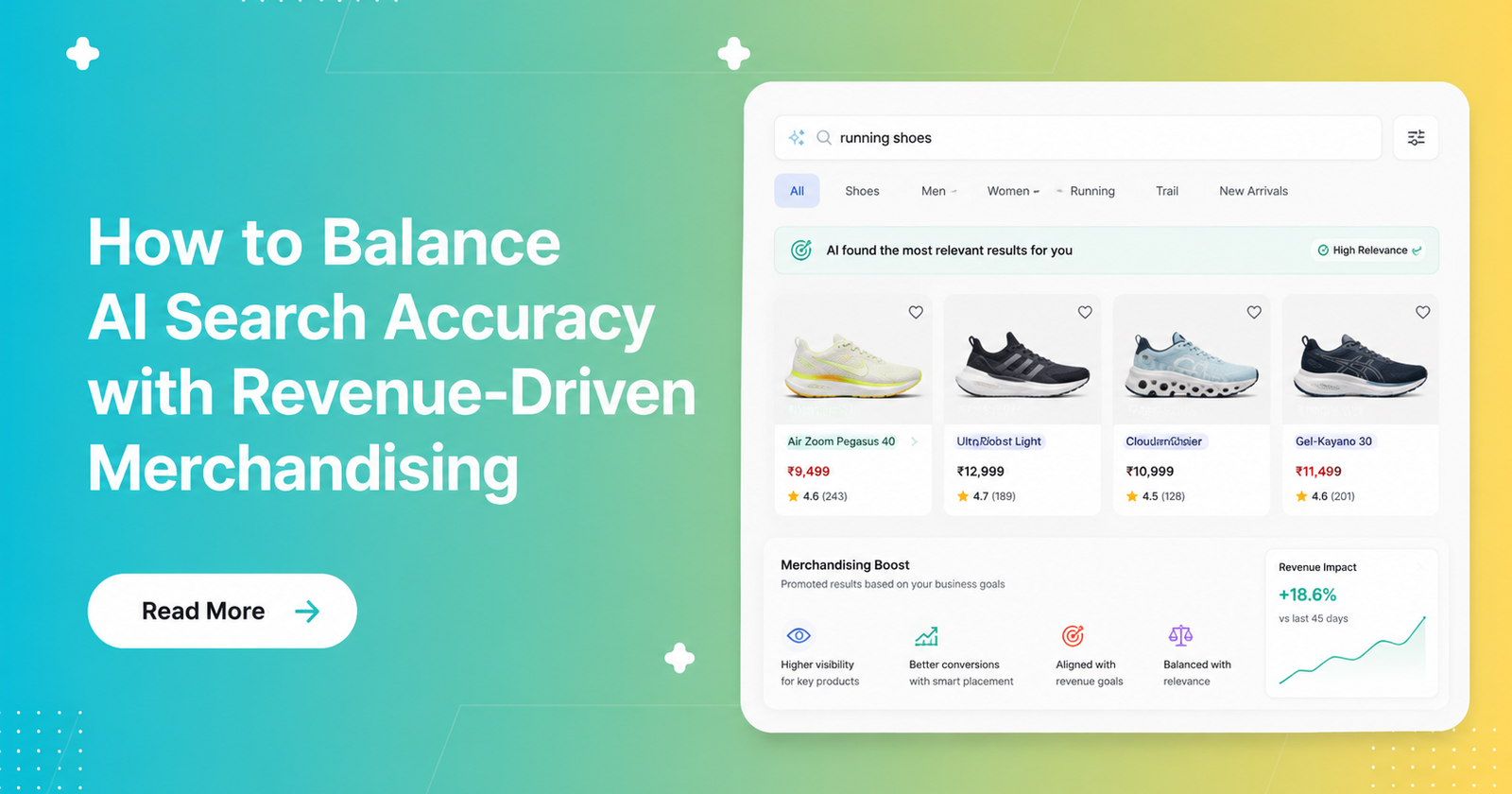
How to Balance AI Search Accuracy with Revenue-Driven Merchandising
AI search has changed ecommerce discovery by making results more relevant, more contextual, and easier to browse. But as brands add merchandising rules, boosts, and promotions, they often face a hard question: how do you keep search accurate while still driving revenue? The answer is balance. Search
AI search has changed ecommerce discovery by making results more relevant, more contextual, and easier to browse. But as brands add merchandising rules, boosts, and promotions, they often face a hard question: how do you keep search accurate while still driving revenue?
The answer is balance. Search should satisfy shopper intent first, but it also needs to support business goals like promoting best sellers, clearing inventory, or increasing margin. If you push revenue too hard, search feels manipulative. If you push accuracy too hard, you may miss merchandising opportunities. The best ecommerce teams build a system that does both.
Why This Balance Matters
Search is one of the highest-intent parts of the customer journey. When shoppers type a query, they are telling you exactly what they want, or at least what they think they want. If your search results ignore that intent, trust drops quickly.
At the same time, search is also a revenue channel. It influences which products get seen, clicked, and purchased. If you never shape results with merchandising logic, you may leave money on the table, especially in categories where some products need more exposure than others.
This is why search optimization cannot be treated as purely technical or purely commercial. It has to serve both shopper relevance and business performance.
What Search Accuracy Really Means
Search accuracy is not just about returning products that match keywords. It is about understanding the shopper’s intent and surfacing the most useful results.
A good AI search engine should recognize:
- Exact product names.
- Synonyms and alternate terms.
- Category intent.
- Style or use-case intent.
- Attribute-based intent.
- Misspellings and language variations.
For example, if someone searches for “running shoes,” the system should not just return any shoe with “running” in the title. It should surface products that are actually relevant to running, based on product data, behavior patterns, and semantic meaning.
Accuracy builds trust. If shoppers feel the store understands them, they are more likely to continue browsing and convert.
What Revenue-Driven Merchandising Does
Revenue-driven merchandising is the practice of shaping search results to support business outcomes. That may include:
- Boosting best sellers.
- Promoting high-margin products.
- Highlighting seasonal items.
- Supporting stock clearance.
- Prioritizing new arrivals.
- Giving visibility to products with strong conversion history.
This is valuable because not all relevant products are equal from a business perspective. Two products may both match a search query, but one may be more profitable, more strategic, or more likely to convert.
Merchandising becomes powerful when it helps the business without breaking the shopper experience.
The Risk of Overdoing Merchandising
The biggest mistake brands make is overusing merchandising rules. If a shopper searches for something specific and sees a heavily promoted but less relevant item first, the result feels off.
That can lead to:
- Lower click-through rates.
- More refinements.
- Higher bounce rates.
- Lower trust in the search experience.
Over time, that hurts revenue more than it helps. Search is supposed to reduce friction. If merchandising gets in the way, you create a subtle but important form of frustration.
That is why the merchant’s job is not to force products into every search result. It is to guide ranking intelligently without undermining intent.
Put Relevance First, Then Layer Business Logic
A strong rule of thumb is to prioritize relevance first and merchandising second.
If a query is highly specific, the closest matching products should appear first. For broad queries, there is more room to optimize based on business goals. That means the merchandising layer should be stronger where shopper intent is weaker and lighter where intent is strong.
For example:
- A query like “black Nike running shoes size 9” should lean heavily toward exact relevance.
- A query like “running shoes” allows a little more room for best sellers, top-rated products, or high-margin items.
This keeps the experience useful while still giving the business room to influence outcomes.
Use Query Intent to Decide the Level of Control
Not every search query deserves the same merchandising strategy. The level of control should depend on query intent.
High-intent queries usually deserve more accurate, literal matches. These shoppers know what they want. If you interfere too much, you risk losing them.
Broader queries can be more flexible. These searches often indicate comparison, exploration, or early-stage discovery. Here, smart ranking can surface products that are both relevant and commercially valuable.
A good AI search system should classify queries into buckets such as:
- Exact product intent.
- Category intent.
- Attribute intent.
- Style intent.
- Exploratory intent.
The merchandising strategy can then adjust accordingly.
Use Boosting Carefully
Boosting is one of the most common merchandising tactics, but it must be used with restraint.
Boosting works best when:
- The product is relevant to the query.
- The product has strong conversion potential.
- The boost does not push better matches too far down.
- The boost supports a clear business goal.
If you boost too aggressively, the relevance layer starts to break down. Shoppers notice when results feel forced, even if they cannot articulate why. A subtle boost is often better than a dramatic one.
The right approach is to boost within a relevant set, not against it.
Best Sellers Are Not Always Best for Every Query
Many stores assume best sellers should always rank first. That is not true. Best sellers are useful signals, but they are not automatically the best answer for every search.
A best seller can help when:
- The query is broad.
- The shopper wants a trusted default.
- The product has high conversion and broad appeal.
But best sellers can hurt when:
- The query is very specific.
- The best seller is not a close match.
- The shopper needs a niche attribute or feature.
That is why a balanced search strategy uses best sellers as one signal among many, not the only signal.
Let Product Data Support the Balance
Good merchandising only works when product data is strong. If the catalog is incomplete, the system cannot know which products are truly relevant or strategically important.
Complete product data helps with:
- Attribute matching.
- Semantic understanding.
- Filter generation.
- Ranking logic.
- Synonym handling.
- Query classification.
The more accurate your catalog data, the easier it is to balance relevance and revenue. Poor data creates false choices, which makes the whole search strategy weaker.
Measure Both Relevance and Revenue
To balance AI search properly, you need to measure both shopper satisfaction and commercial performance.
Useful metrics include:
- Search click-through rate.
- Zero-result rate.
- Search refinement rate.
- Add-to-cart rate.
- Conversion rate.
- Revenue per search session.
- Average order value.
- Product margin contribution from search.
If revenue goes up but click-through and conversion quality drop, the merchandising is probably too aggressive. If relevance is strong but revenue impact is low, the search may need smarter commercial tuning.
You need both sides of the picture to make good decisions.
Segment by Category
Different categories tolerate merchandising differently. Fashion shoppers may be more open to discovery-based ranking. Electronics shoppers often expect precision. Home and furniture shoppers may care more about style and use-case fit. Beauty shoppers may respond well to curated recommendations.
That means the balance between accuracy and merchandising should change by category. A one-size-fits-all rule is rarely the right answer.
For example:
- Fashion: more room for style-led boosts.
- Electronics: stronger need for exact attributes.
- Beauty: balance between relevance and inspiration.
- Home: mix of style, price, and practical fit.
Category-specific logic creates a better shopping experience and a smarter revenue strategy.
How AI Helps Maintain Balance
AI search can make this balance easier because it can learn from both customer behavior and business outcomes.
It can use signals such as:
- Click-through patterns.
- Purchase history.
- Product popularity.
- Margin data.
- Inventory levels.
- Query context.
- User preferences.
Instead of relying on a rigid set of rules, AI can adapt ranking dynamically. That allows the system to stay relevant while still supporting revenue goals.
This is especially useful for stores with large catalogs or frequent inventory changes, where manual merchandising becomes hard to maintain.
A Practical Framework
A simple way to balance AI search and merchandising is this:
- Identify the shopper’s intent.
- Return the most relevant products first.
- Apply modest merchandising only within the relevant set.
- Use stronger commercial tuning for broad or exploratory queries.
- Measure both engagement and revenue.
- Refine by category and query type.
This framework keeps the shopping experience centered on the customer while still allowing the business to influence outcomes.
Final Thought
The goal of AI search is not just to find products. It is to find the right products in a way that also supports the business. That is why balancing accuracy with revenue-driven merchandising matters so much.
If you respect shopper intent, use merchandising carefully, and rely on strong product data and performance metrics, you can build a search experience that feels helpful and still drives growth.
The best search strategies do not force a choice between relevance and revenue. They use both to create a better ecommerce experience.