
What Search Behaviour Can Reveal About Changing Customer Preferences
Search queries, filters, and product interactions can reveal useful insights into shopper behaviour. Learn how ecommerce brands can interpret search trends, understand customer needs, and make smarter product discovery decisions.
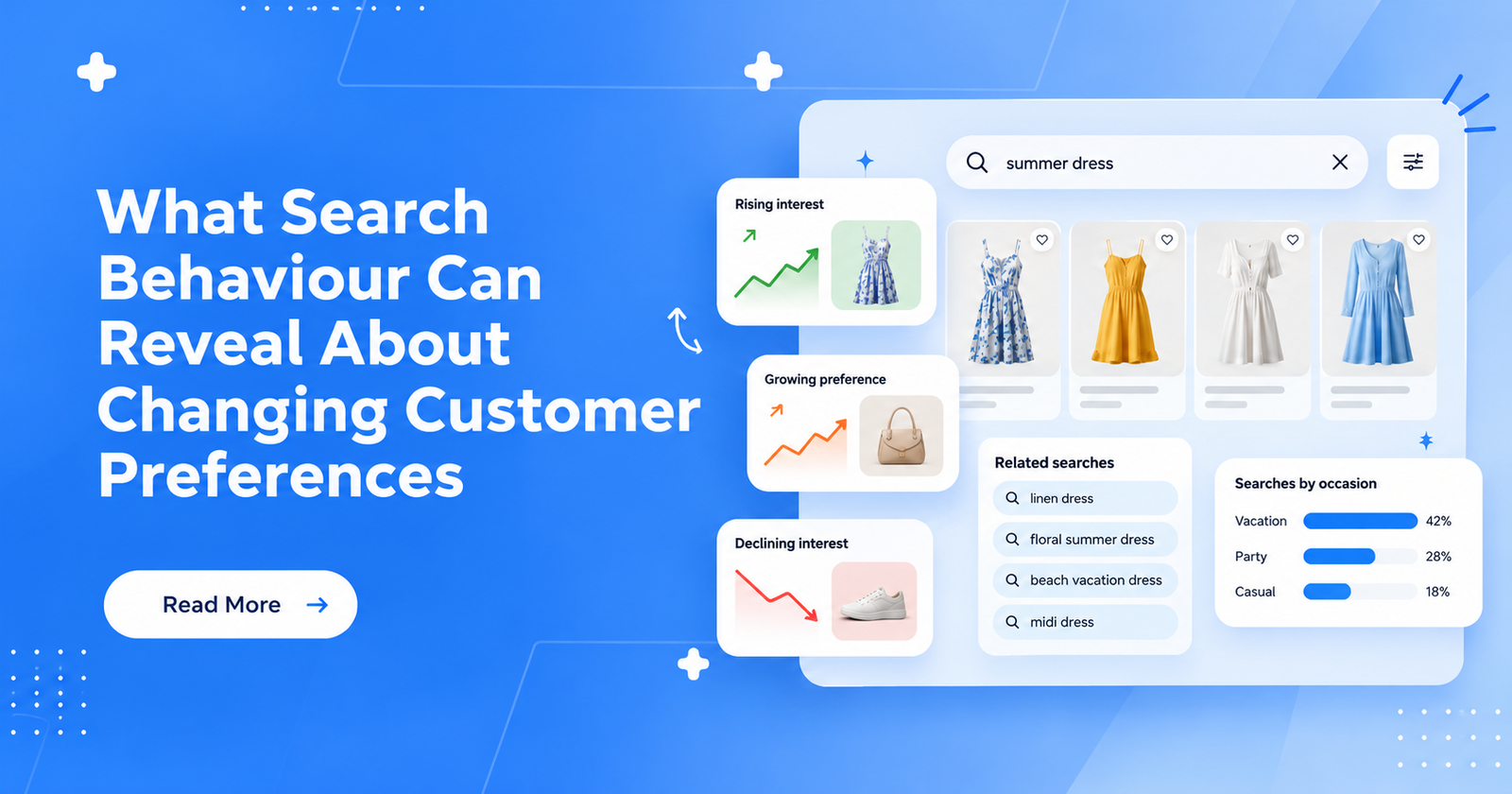
What shoppers search for can tell ecommerce brands a lot about what they need.
A rise in searches for a particular product, more frequent use of certain filters, or a change in the words shoppers use can reveal interesting patterns.
But does that mean customer preferences are changing?
Not necessarily.
For example, if more people start searching for “linen shirts,” it might mean linen is becoming more popular. But it could also be because of a seasonal trend, a marketing campaign, or a new filter that makes linen products easier to find.
The real challenge is understanding what these changes mean before making business decisions based on them.
1. Start With What Shoppers Are Searching For
Search queries are often the first place to look for changes in shopper behaviour.
Imagine your store starts receiving more searches for “running shoes under ₹5,000.”
This tells you that shoppers are looking for running shoes within a particular price range. If similar searches become more common over time, that pattern may be worth exploring.
But it doesn't automatically mean shoppers are becoming more price-conscious. A sale, a change in your audience, or a new campaign could explain the increase.
Instead of jumping to conclusions, look at the pattern first.
Ask yourself:
- Which search terms are becoming more common?
- Are shoppers mentioning specific colours, materials, sizes, or price ranges?
- Are these changes happening across the category or only in certain groups?
- Is the pattern continuing, or was it temporary?
These questions help you identify what is changing without assuming you already know why.
2. Look Beyond Search Queries
What shoppers type into the search bar is only one part of the story. Their interactions with your store can offer additional clues.
Filters can reveal what shoppers want to narrow down.
If more shoppers select a particular size, colour, or material, it may suggest that the attribute matters to their current shopping needs.
However, check whether the filter was actually visible and easy to use. A newly introduced or more prominent filter can receive more selections simply because more shoppers notice it.
Search refinements can reveal how shoppers clarify their needs.
Someone might search for “shirts” and then refine the query to “linen shirts.”
This could mean they have become more specific about what they want. It could also mean the first results weren't relevant enough, or they simply followed a search suggestion.
Product clicks can show what catches shoppers' attention.
If a particular type of product starts receiving more clicks, investigate whether it is genuinely more relevant to shoppers or simply appearing higher in the results.
Clicks are useful signals, but they don't always tell you why someone chose a product.
The key is to look at these interactions together rather than treating any single action as proof of a changing preference.
3. Compare Similar Periods Before Drawing Conclusions
A trend can look significant until you understand what happened during the same period.
Suppose searches for summer dresses increase in April. That might reflect growing interest in the category, but it could also be a normal seasonal pattern.
Similarly, a campaign promoting linen clothing might bring more shoppers to those products without changing what your existing customers prefer.
Before comparing search activity, check:
- Seasonality: Are shoppers responding to a particular time of year?
- Marketing campaigns: Did you promote specific products or categories?
- Product availability: Were the products and requested variants in stock?
- Search rankings: Did certain products become easier to find?
- Website changes: Were new filters, suggestions, or search features introduced?
It's also important to compare similar periods and traffic groups wherever possible.
For example, if paid campaigns brought significantly more visitors to your store this month, compare search behaviour within similar traffic groups rather than looking only at the overall increase.
One more thing: make sure your analytics captures the same interactions in both periods. Some search tools track results-page searches but exclude predictive-search interactions. A change in tracking can make behaviour appear different even when shoppers haven't changed how they shop.
4. Understand the Difference Between Interest and Demand
One of the biggest mistakes ecommerce teams can make is treating search activity as a direct measure of demand.
Imagine shoppers repeatedly search for a particular type of shoe, but your store doesn't have their preferred sizes.
Those searches may indicate that shoppers are trying to find something relevant. But they don't tell you how many would actually buy the product, what price they would accept, or whether stocking more inventory would be profitable.
Before making an assortment decision, check whether the products exist, whether their attributes are accurate, and whether the required variants were available.
If shoppers can't find a product because its information is incomplete, improving the catalog may be more useful than adding new inventory.
If the product genuinely isn't available, the pattern may be worth sharing with your merchandising or buying team for further investigation.
Search data can help you identify opportunities. It cannot, on its own, guarantee that those opportunities will translate into sales.
5. Look for Other Evidence
Once you notice a pattern, look for additional evidence that helps explain it.
For example, if searches for linen clothing continue to increase, you could examine related search terms, filter usage, and product interactions over time.
You could also review relevant customer support questions or conduct customer research to understand what shoppers are looking for.
Each source has its limitations, but together they may help you build a clearer picture.
Be careful not to count several related signals as independent proof. A marketing campaign could increase searches, clicks, and purchases at the same time. Those changes might all have the same underlying explanation.
It's equally important to consider evidence that challenges your initial assumption.
If searches for a product attribute increase only during a campaign and return to normal afterwards, the pattern may be temporary rather than a lasting shift.
The goal isn't to prove your first guess right. It's to understand which explanation best fits the evidence available.
6. Turn Search Insights Into Action
Once you have investigated a pattern, decide what action, if any, makes sense.
Not every change in search behaviour requires a change to your store.
Here are some examples of how ecommerce teams can act on different findings.
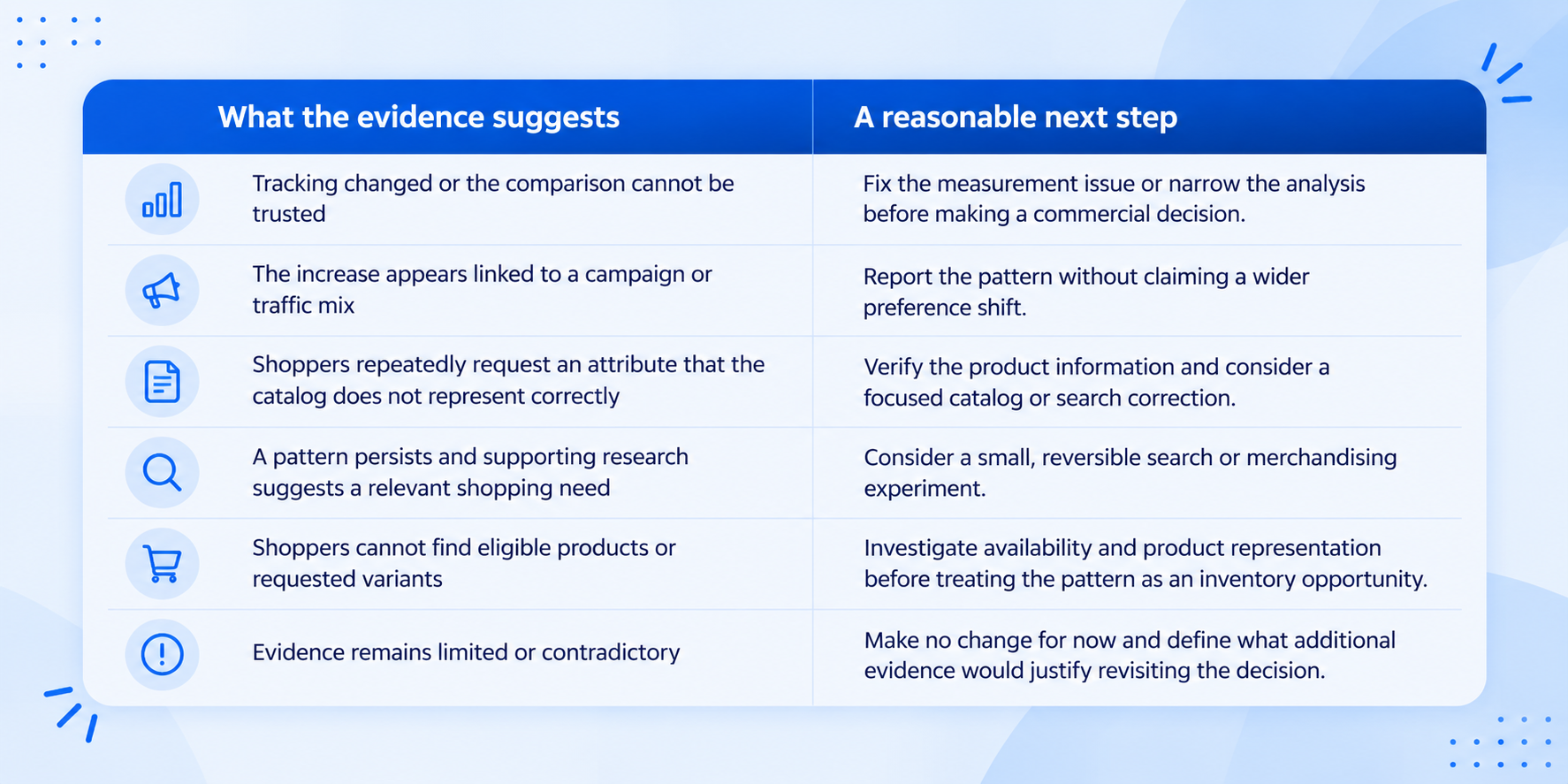
For example, you might improve a product attribute, adjust a filter's placement, or test a different way of presenting relevant products.
Measure what happens after the change and watch for unintended effects. If the change makes one group of products easier to discover but makes other searches less useful, you may need to revisit it.
Whenever possible, use a controlled test rather than relying only on a before-and-after comparison. This makes it easier to distinguish the effect of your change from other things happening at the same time.
And remember: even if a change improves results, it doesn't necessarily prove that customer preferences changed. It shows that the intervention had an effect in the context you tested.
A Quick Checklist for Ecommerce Teams
Before acting on a search trend, ask yourself:
- Are we seeing a genuine change in comparable search activity?
- Could a campaign, seasonal trend, or website change explain it?
- Are shoppers able to find the products and variants they want?
- Do filters, clicks, and search refinements support the same interpretation?
- Do we have enough evidence to justify a change?
- Can we test the change before making a bigger decision?
If you don't have clear answers yet, further investigation may be the right next step.
Final Thoughts
Search behaviour can help ecommerce brands understand what shoppers are looking for and where they might be struggling to find the right products.
But a change in searches doesn't always mean a change in preferences.
Sometimes shoppers have different needs. Sometimes they are responding to a campaign, exploring their options, or adapting to the way a store presents its products.
The important thing is to look beyond the numbers, understand the possible explanations, and act only when the evidence supports it.
Search data doesn't tell you everything about your customers. But when you interpret it carefully, it can help you make better decisions about how shoppers discover products.