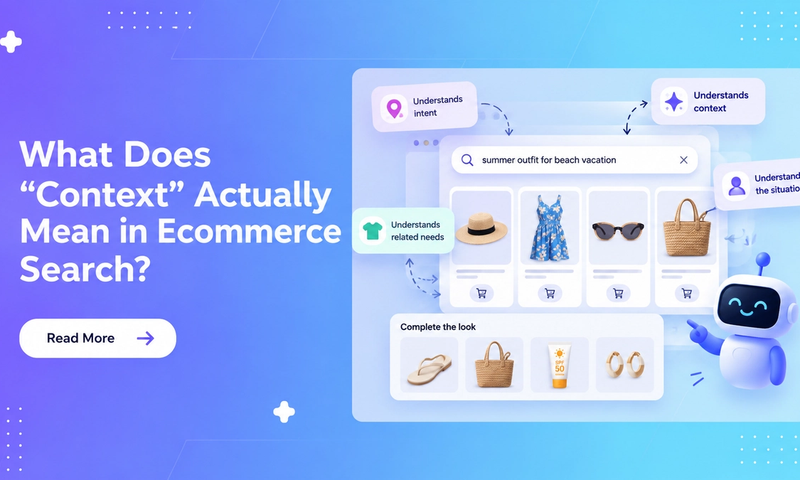
What Does “Context” Actually Mean in Ecommerce Search?
Context in ecommerce search is more than AI understanding a query. Learn how shopper input, product data, availability, and interaction signals can influence which products appear and why.
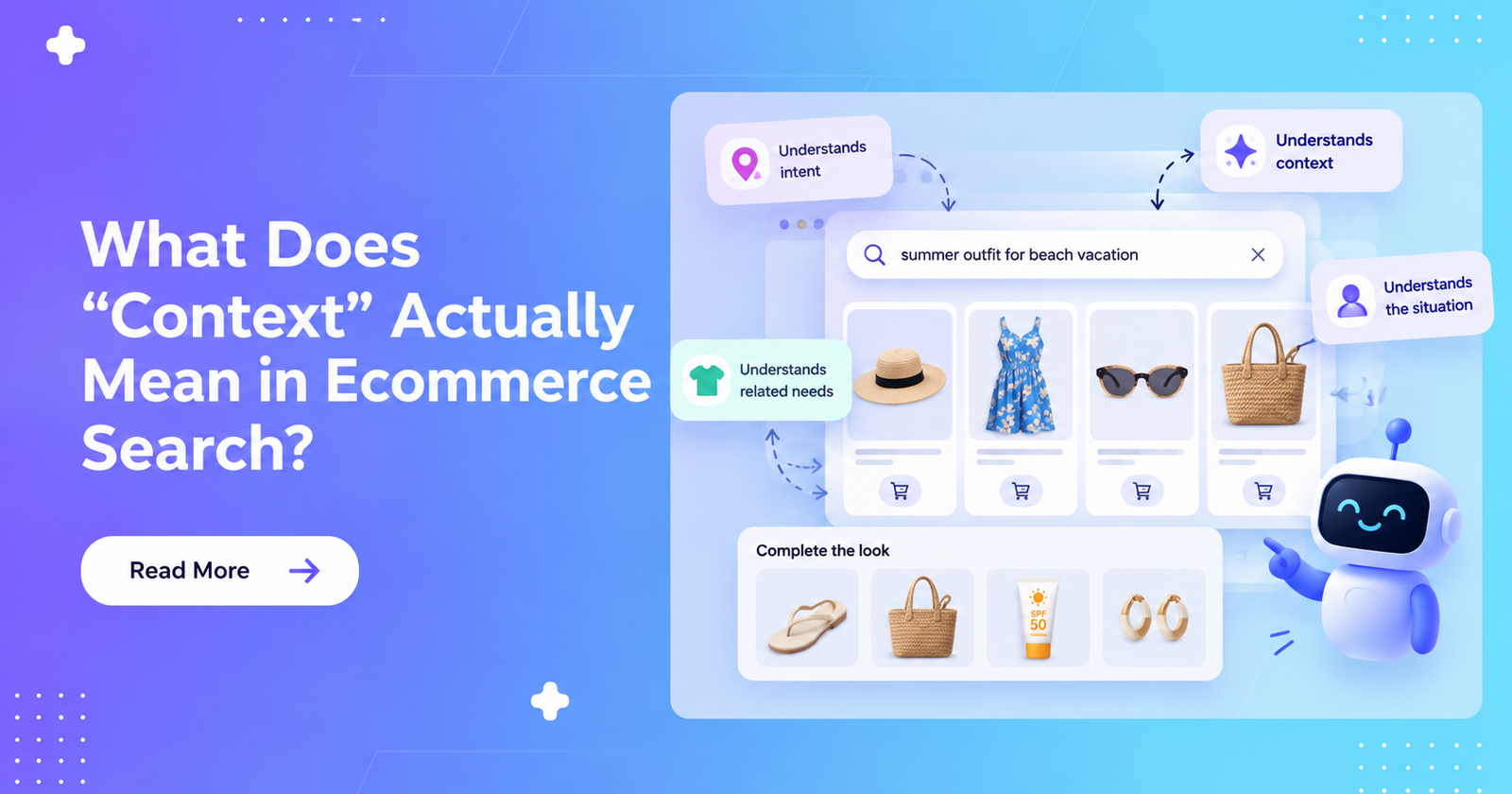
In ecommerce search, context is the evidence around a search decision that can change whether a product is eligible, relevant, or correctly ordered. It includes what the shopper explicitly said or selected, facts about the product and exact variant, whether that item is eligible and available in the current storefront context, and what later interactions may suggest.
This distinction matters for ecommerce search relevance because a matching word is useful evidence, but not always enough. A result can contain the query term and still violate a selected size, lack a required attribute, represent an unavailable variant, or confuse a similar product code with the exact one.
Some context is direct. A query, selected filter, or confirmed answer is visible input for the current task. Other context is inferred. A click, previous purchase, popularity pattern, or semantic similarity may support a hypothesis, but it does not automatically become a shopper-confirmed fact.
The four-layer model, precedence rule, examples, misfire grouping, exact-identity protection rail, and final review questions in this article are original editorial analysis. They are an inspection model, not an industry standard, measured funnel, universal system architecture, or description of a Wizzy product. The narrower platform and research sources linked below support only the specific distinctions attributed to them.
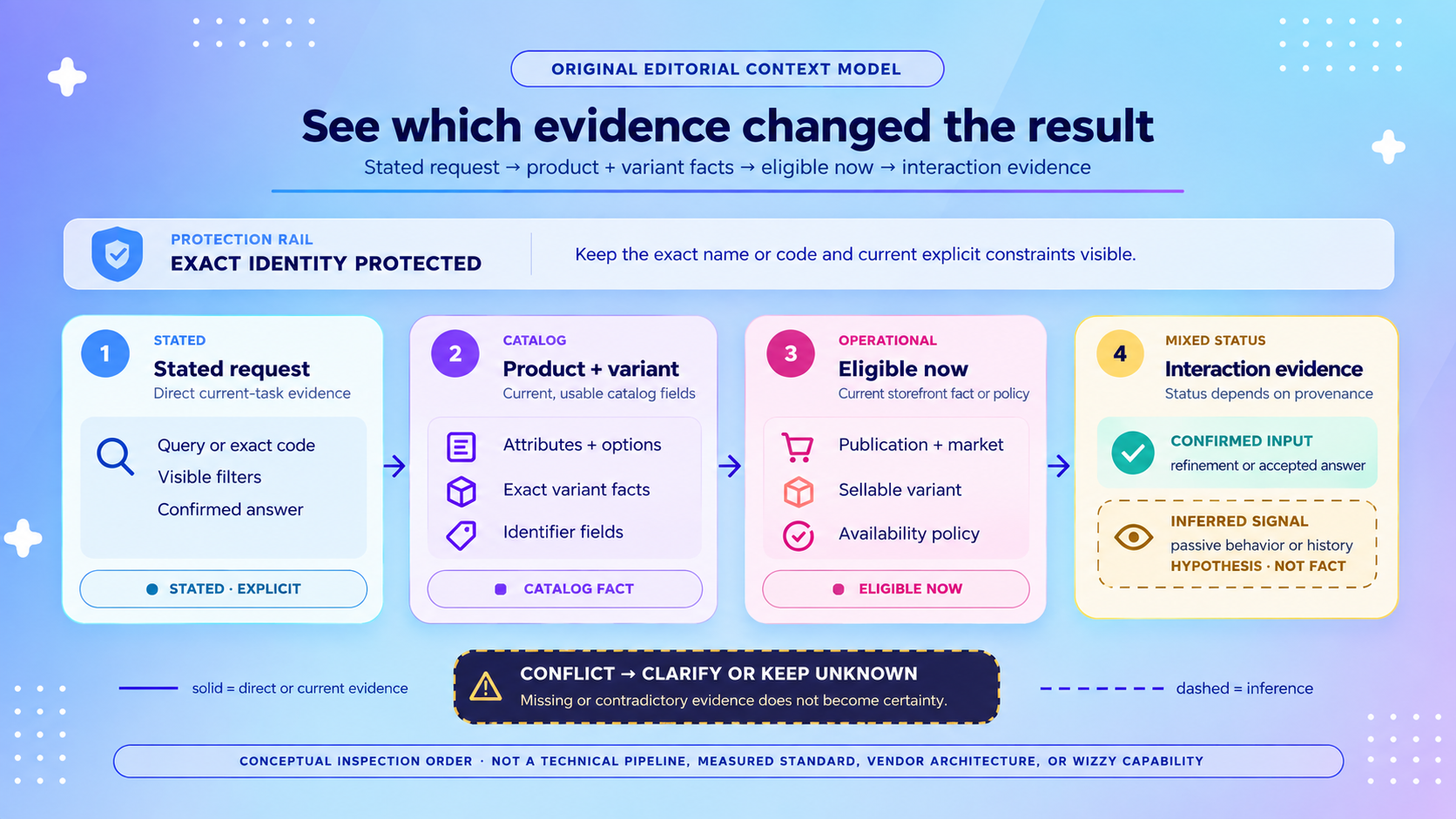
Context is evidence around a search decision, not a synonym for AI
A term match establishes that a word or value appears in the searchable representation of a product. It does not, by itself, establish that the result is the right variant, satisfies a hard constraint, can be sold in the current market, is compatible with another item, or represents the exact identity the shopper supplied.
A hard constraint is a stated requirement that must not be silently softened—for example, size M, under $150, in stock, or compatible with model X. Eligibility means that a product or variant is allowed to appear or be sold under the storefront policy being tested. Exact identity means that the task is to locate a particular record, such as a valid SKU, model number, product code, or exact product name.
One documented commerce-search system distinguishes candidate matching from relevance ranking and allows a request to carry query, filter, availability, and other context (Google Cloud search documentation). That is a useful named example, not proof that every platform uses the same architecture or signals.
The more useful question is therefore not “Does the product match a word?” but “What evidence authorizes this product to appear here, in this position, for this task?” Four sources can contribute:
- what the shopper stated or visibly selected;
- what the catalog says about the product or exact variant;
- whether the item is eligible and available now; and
- what confirmed or inferred interactions add.
These are evidence sources, not competing search technologies. Lexical matching, semantic retrieval, structured filters, and behavioral reranking can coexist. Elastic, for example, documents full-text, semantic, and hybrid approaches as distinct but combinable methods (search approaches; hybrid search). That product-specific example does not establish one correct design. It shows why “context” should describe what a signal establishes, not serve as shorthand for whichever method produced it.
Use four layers to inspect why a result appears
For ecommerce search relevance, the following context stack provides a consistent way to inspect what affected a result. It is an original editorial aid, not a technical pipeline, standard vocabulary, or claim that every search system evaluates evidence in this order.
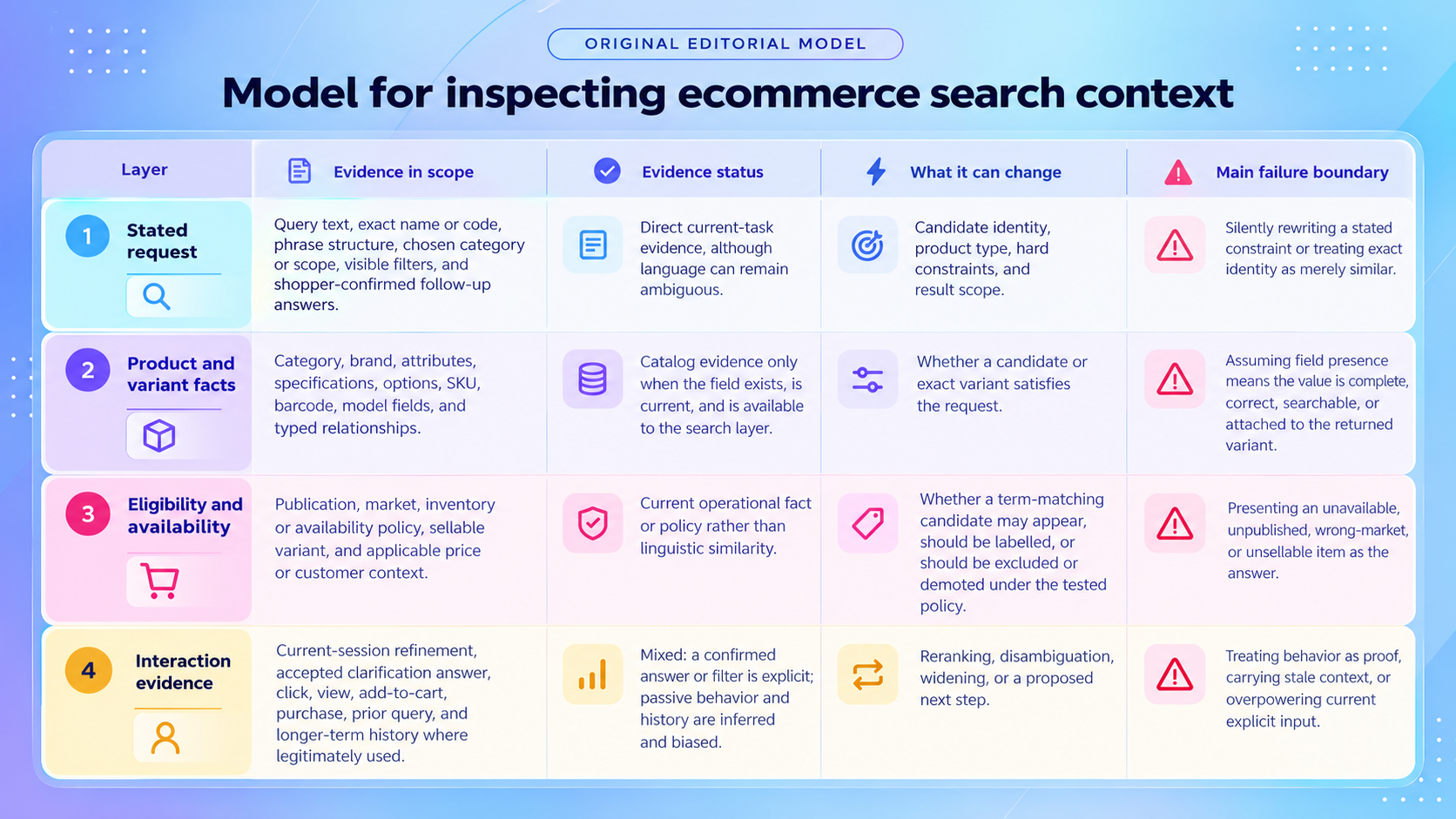
Layer 1 — the stated request
Start with what the shopper can inspect: the query wording, any exact identifier, the selected scope, visible filters, and answers the shopper has explicitly confirmed. Direct input can still be ambiguous, but it should not be silently rewritten.
Shopify provides one concrete example of this separation. Its storefront documentation describes a query alongside separate controls for result type, unavailable-product handling, partial matching, and sorting. Its filtering documentation describes applied product and variant filters represented in URL state (Shopify storefront search; Shopify storefront filtering). These mechanics do not prove that every requirement is represented or that any result is correct. They show how visible state can exist outside the query words themselves.
Layer 2 — product and variant facts
A product title may match while the required fact lives at variant level. Category, material, technical specification, size, SKU, barcode, model, or a typed compatibility relationship can determine whether the candidate actually satisfies the request.
Shopify’s product-variant reference, for example, documents variant options, SKU, barcode, inventory links, availability-for-sale, and publication information separately from the parent product (Shopify ProductVariant). Google’s product-specific documentation separately distinguishes searchable, facetable or indexable, retrievable, and exact-searchable attribute roles (Google Cloud attribute configuration). Neither source proves what another platform indexes or ranks. They establish a narrower point: a field can exist without being complete, current, searchable, or attached at the granularity the returned result implies.
Layer 3 — eligibility and availability
A product can be linguistically similar and operationally ineligible. Publication state, market, sellable variant, applicable inventory policy, and other current storefront rules are not synonyms or semantic clues. They are operational evidence.
What should happen to an unavailable item depends on the tested storefront policy. It may be excluded, demoted, or clearly labelled. The important boundary is that the interface must not present the item as an eligible answer when the relevant policy says otherwise. Google documents product-specific filter predicates over fields including category, availability, color, size, material, custom attributes, inventory-level fields, and price (Google Cloud filtering). That demonstrates available mechanics in one system, not the right policy for every merchant.
Layer 4 — interaction evidence
Not every interaction has the same evidential status. A current-session refinement or accepted follow-up answer is explicit current-task input. A click, view, cart event, purchase, prior query, or longer-term history is an observation from which a system may infer something.
Google documents search, product-view, add-to-cart, cart-page, and purchase events as possible inputs in its product (Google Cloud user events). Recording an action does not prove current intent, fit, satisfaction, or causation. The event is a fact about what happened; its meaning for the next search decision remains an inference.
Apply the precedence rule conservatively
For this inspection model, use the following original practical rule:
- Preserve exact identity and current explicit hard constraints.
- Check the exact product and variant facts that can satisfy them.
- Enforce current eligibility and availability policy at the correct granularity.
- Use interaction or semantic evidence to rank, widen, clarify, or propose only where it does not contradict stronger evidence.
- When explicit signals conflict or required facts are missing, expose the conflict, ask a useful question, or keep an honest unknown instead of inventing certainty.
This is a conservative recommendation, not a measured rule. A real implementation needs catalog-, category-, policy-, and task-specific testing. Authority, here, means what a signal is entitled to change given its source and status. Confidence must not be confused with authority: a predictive historical signal may be strong without being authorized to override an exact code, selected size, market restriction, or current availability fact.
Separate explicit context from inferred context
Explicit context is visible or directly supplied for the current task. It includes query text, an exact name or identifier, selected category or scope, visible filters, a confirmed clarification answer, and the current storefront or market state where it is explicitly applied. Current product and variant facts can then be used to test that request, subject to data quality and search availability.
Inferred context is a hypothesis. A click may suggest short-term interest. Repeated views or purchase history may suggest affinity. Popularity may suggest what other shoppers selected. Semantic similarity may suggest relatedness. These signals can inform a proposal or ranking decision, but they do not prove the shopper’s present need.
The language used to describe the signal should preserve that status. Prefer “may suggest,” “can inform,” or “can support a proposal” to “reveals,” “knows,” or “proves.” An inference can be useful without being treated as fact.
A narrow academic product-search study used within-session clicks as short-term context for later result pages and reported improved reranking in its dataset (study record). That supports “can inform” in that setting, not “clicks reveal intent.” Broader peer-reviewed search research concludes that clicks are informative but biased when treated as absolute relevance judgments (ACM research record). It is web-search evidence rather than an ecommerce benchmark, so it supplies a guardrail rather than a retail metric.
A confirmed follow-up answer changes status. Before confirmation, a system’s interpretation remains inferred. Once the shopper explicitly chooses an offered size, category, or attribute, that answer becomes direct current-task context. Google documents one product-specific flow in which an attribute question is asked and the answer is applied as a filter (Google Cloud conversational filtering). The example does not establish a universal question order or interface. Readers who need the separate surface-handoff model can explore how search, filters, recommendations, and clarification can hand context forward.
For any contextual signal, ask:
- What was observed?
- Was it stated, confirmed, catalogued, operational, or inferred?
- How current is it?
- Which decision did it change?
- What stronger evidence could contradict it?
This status checklist is original practical guidance. Its purpose is to keep provenance visible rather than place every signal under one vague “context” label.
See why a term-matching product can still be wrong
The examples below are hypothetical. They are not merchant queries, customer stories, observed failures, product tests, or claims about any platform. Each example shows how a plausible term match can remain insufficient when another evidence layer disagrees or stays unknown.
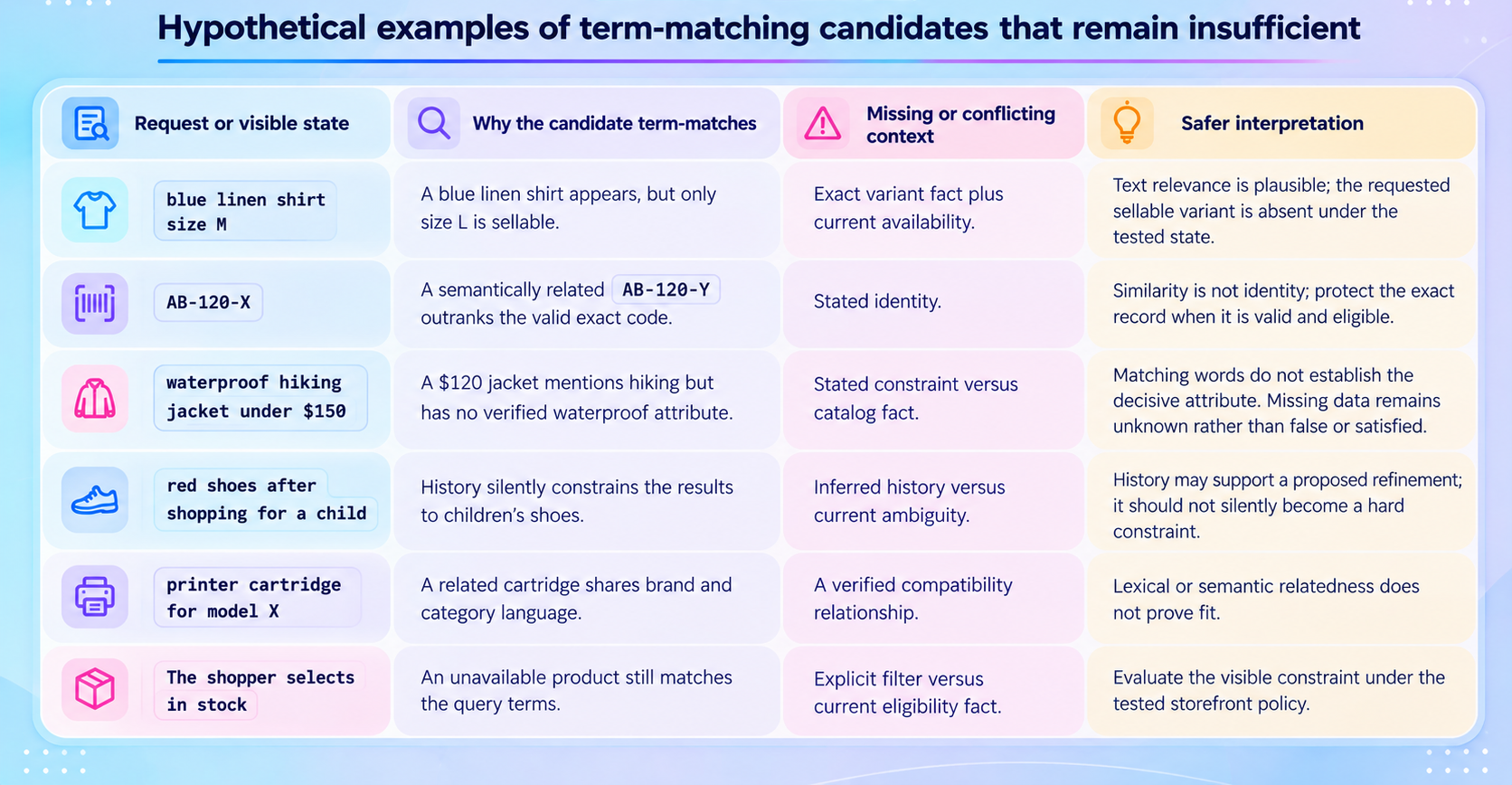
The lesson is not that term matching failed or that semantic retrieval caused the problem. In each case, the term match supplied one plausible piece of evidence. The error came from treating it or an inference around it as sufficient authority for a different decision.
Know when inferred context can mislead
Inferred context deserves particular care because it can feel persuasive without being decisive. The following six conditions are an original, non-exhaustive grouping. No reviewed source establishes how often they occur, how severe they are, or one universal response.
The signal is stale
A prior purchase or view may reflect a completed need, a gift, a previous mission, or a shared account. Current explicit input should take priority unless the older context is reaffirmed. The product-search study cited earlier distinguishes short-term session context from longer-term preference in its own dataset; it does not establish a safe retention period or preference lifetime.
The action is ambiguous
A click can represent interest, comparison, accidental selection, price checking, or dissatisfaction with other options. It can inform a hypothesis but cannot serve as absolute proof of relevance. The same caution applies to a view, cart action, or purchase when the current task differs.
The catalog fact is missing, stale, or misattached
Missing data is not the same as false. A field may be present at parent-product level while the decision depends on the exact variant. A correct real-world property may be absent from the search layer, and an indexed value may no longer be current. Product and attribute documentation demonstrates that roles and granularity can differ; it does not guarantee data quality.
Similarity is mistaken for compliance
Lexical or semantic relatedness does not inherently enforce price, size, compatibility, availability, exact identity, or another hard requirement. Elastic’s hybrid documentation and Walmart’s research on combining an inverted index with neural retrieval provide named examples of coexistence, not automatic correctness (Elastic hybrid search; Walmart research record).
Aggregate behavior becomes a hidden hard rule
As an original review precaution, ask whether a popularity or co-click signal is turning past exposure into a hidden requirement. That does not make behavioral evidence useless. It means an inferred aggregate pattern should be reviewed against explicit judged cases rather than silently converted into a rule the current shopper did not state.
Context sources conflict
A profile may imply one category, current-session behavior another, and the current query a third. No reviewed source supplies a universal conflict resolver. Prefer a reversible proposal, a useful clarification, or an explicit unknown over silent certainty.
These conditions do not prove that historical personalization is harmful or that behavioral context is unreliable. They show why inferred evidence needs provenance, limits, and a path for contradiction.
Protect exact retrieval where identity is the job
Context should strengthen literal retrieval where the task depends on identity, not erase it. When a shopper supplies a valid SKU, barcode, serial number, model, manufacturer ID, product code, or exact product name, the literal value may be the strongest available evidence.
Named systems document mechanics suited to this distinction. Google describes exact-searchable attributes for targeted identifier values. Elastic describes keyword fields for structured values such as IDs and term-level queries (Elastic keyword fields). Independent ecommerce UX research also recognizes exact or model-number searches as a distinct shopper behavior (Baymard Institute). These sources do not establish universal normalization, typo tolerance, weighting, or ranking rules.
Exact matching is not limited to codes. Brand names, technical terms, and exact phrases can carry meaning that broader matching should complement rather than erase. A single source value can also support more than one representation; Elastic documents multi-fields as one product-specific example of indexing a string in different ways for full-text and keyword-oriented uses (Elastic multi-fields).
This does not mean an exact match should always rank first. The record still needs to be valid, attached to the right product or variant, and eligible under the current storefront policy. Nor does it mean literal matching alone handles synonyms, paraphrases, or use-case language. The protection rail is narrower: when identity is the job, semantic similarity or behavioral confidence must not silently convert a nearby item into the exact one.
Catalogs with known-item, attribute-heavy, or compatibility-sensitive tasks need more detail than this explainer provides. The separate guide explains why part numbers, product attributes, and compatibility need different retrieval contracts.
Review context by asking what changed and what authorized it
A useful review does not try to maximize the amount of context. It makes the source and authority of each signal inspectable. For any result or ordering change, use this six-question habit:
- Name the context source. Was it a query, filter, confirmed answer, product or variant field, eligibility or availability policy, interaction, or history?
- Classify its status. Was it shopper-stated, shopper-confirmed, catalogued, operational, or inferred?
- Name the decision it changed. Did it affect candidate identity, hard-constraint satisfaction, eligibility, ordering, widening, clarification, or a proposed next step?
- Look for stronger or conflicting evidence. Is there an exact identifier, visible hard constraint, current variant fact, market or publication state, or availability fact that disagrees?
- Preserve uncertainty. If required evidence is missing or contradictory, clarify, propose reversibly, or keep the unknown visible.
- Test in the real catalog context. This model supplies vocabulary and hypothetical examples, not a universal implementation or acceptance test.
This checklist is original practical guidance. It does not validate a platform, choose an architecture, settle governance or legal questions, or guarantee an outcome.
The central question for ecommerce search relevance is simple: Which context changed this result, and was it a fact, a confirmed choice, or an inference? Context is useful when that answer remains visible. Exact identity and current explicit constraints retain their authority; product and variant facts are checked at the right granularity; eligibility is treated as an operational condition; and interaction evidence remains a proposal where it has not been confirmed.
A term match is neither the whole answer nor an obsolete technique. It is one form of evidence. The goal is to use the right evidence for the current decision without converting prediction into fact, missing data into certainty, or similarity into identity.