When Should an Ecommerce Business Invest in Advanced Search and Product Discovery?
Not every ecommerce business needs a new search platform. Discover how to evaluate recurring shopping problems, existing search limitations, investment costs, and implementation readiness before deciding whether to upgrade, fix the basics, or stay with your current solution.
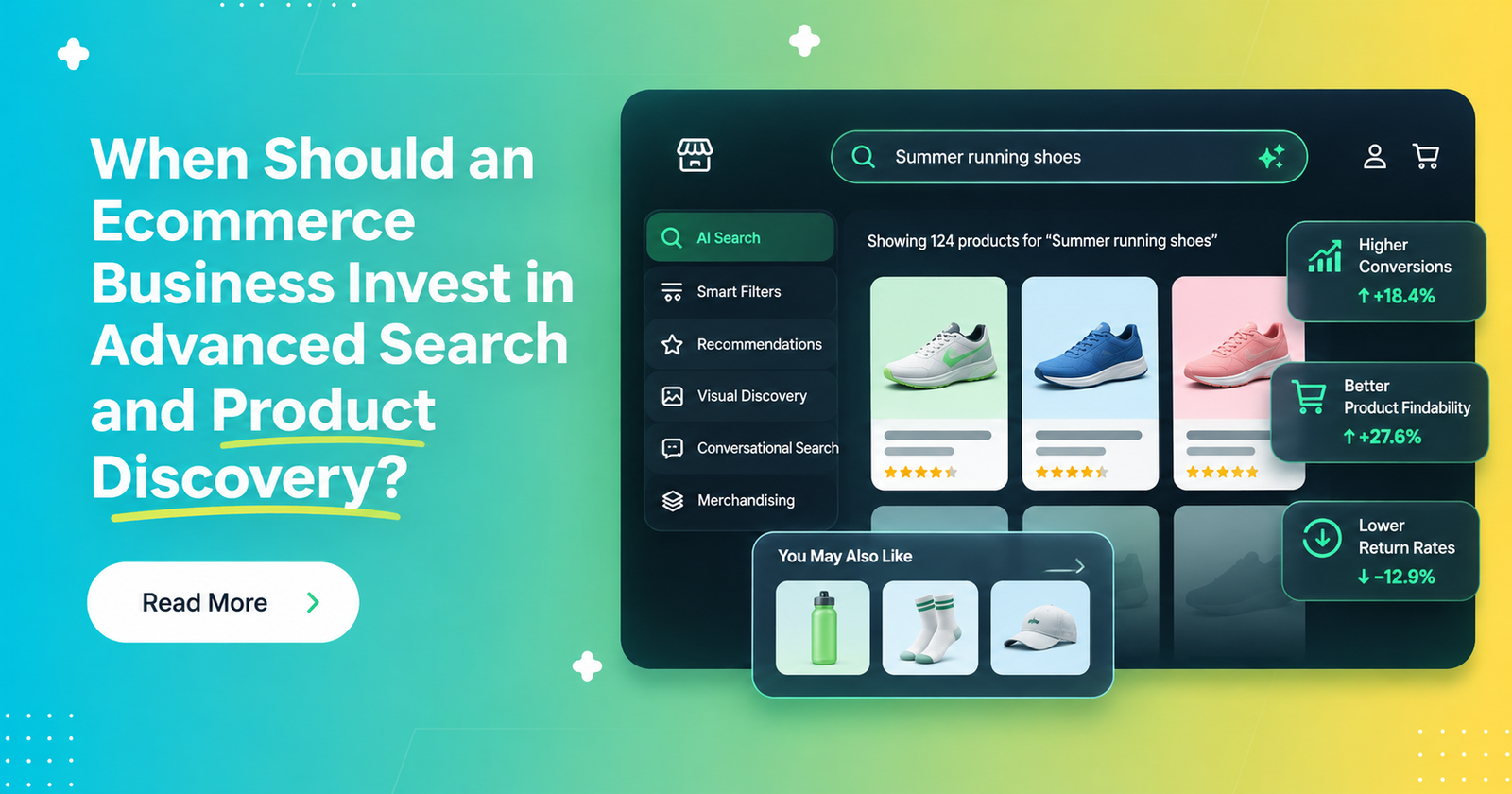
As an ecommerce business grows, helping shoppers find the right products can become increasingly challenging. A growing catalog, changing customer preferences, and more complex product details can put pressure on your existing search and discovery experience.
But does that automatically mean you need a new search platform?
Not necessarily.
Sometimes, a few improvements to your existing setup are enough. In other cases, your current solution may no longer be able to handle what your business needs.
The important thing is knowing when to improve what you already have and when it's time to consider something more advanced.
In this guide, we'll look at the signs to watch for, the costs to consider, and how to make a more informed decision before investing in an advanced ecommerce search and product discovery solution.
Start With the Problems Your Shoppers Face
Before looking at new platforms, understand where your current shopping experience is falling short.
Think about the tasks shoppers regularly perform on your website:
- Can they find a specific product when they know its name or model?
- Can they narrow down hundreds of products using filters?
- Can they find the right variant, size, or product specification?
- Do they get useful results when they search using everyday language?
- Can your merchandising team make changes without affecting important product requirements?
These questions help you identify whether your current search experience is meeting actual shopper needs.
According to Baymard's ecommerce search research, shoppers use different types of searches, from exact product names to broader product-category queries. This is why looking at just one search metric may not give you the complete picture.
However, improving search results is only one part of the bigger picture. Product discovery goes beyond search and includes how shoppers navigate categories, explore recommendations, and decide which products are right for them.
Instead of focusing on one unsuccessful search, keep track of recurring problems. Note what shoppers searched for, what results they expected, what appeared, and whether the same issue happened again.
One unsuccessful search doesn't necessarily mean your platform is failing. But when shoppers repeatedly struggle to complete important tasks, it's worth investigating.
Is Your Product Catalog Becoming More Difficult to Manage?
Having more products doesn't automatically mean you need advanced search.
What matters is how complicated those products are to organise and find.
For example, a store selling thousands of similar products with consistent information may have relatively simple search requirements.
On the other hand, a smaller store selling technical equipment may need to handle complex specifications, compatibility requirements, product variants, and supplier-specific terminology.
Look at the information your shoppers use to make decisions:
- Product attributes and specifications
- Sizes, colours, and variants
- Compatibility between products
- Different product names and terminology
- Stock availability across locations
- Multiple languages and markets
Also, distinguish between missing product information and limitations in your search platform.
If your catalog doesn't contain accurate compatibility information, replacing your search solution won't automatically fix that problem.
As ecommerce evolves, product discovery is also moving beyond traditional search experiences. Explore how product discovery is evolving from search to AI agents and what this means for ecommerce brands.
Understand What Your Current Search Solution Can and Cannot Do
Before replacing your existing setup, make sure you're using its available capabilities properly.
Sometimes, the problem isn't the platform itself. It could be incorrect configuration, missing product information, or limitations in your website theme.
For example, Shopify already offers several search and discovery capabilities.
Its storefront search includes features such as predictive search and typo tolerance. Its free Search & Discovery app also provides options for synonyms, product boosts, filters, and analytics.
However, having access to these features doesn't automatically mean they're configured or working correctly.
Shopify's search customisation guidance explains how product information and theme settings can affect search behaviour. Its filter documentation also notes that filters may not appear if the theme doesn't support them.
So, before deciding that your current platform is no longer enough, check:
- Are your search settings configured properly?
- Is the relevant product information available?
- Are your filters working as expected?
- Does your website theme support the features you've enabled?
- Are there existing features you haven't explored?
Your search data can also reveal where shoppers are struggling. Learn how query intelligence helps brands optimise search and filters by turning shopper queries into actionable insights.
If you're dealing with empty search results, first understand whether the search actually failed. Sometimes, a shopper's requirements simply don't match any available product. Read more about when no results is the correct outcome.
The goal isn't to keep fixing the same problem forever. It's to understand whether a reasonable improvement can solve it or whether your current solution has reached its limits.
When Should You Consider a New Search Solution?
Once you've checked your existing setup, look at the problems that remain.
For example:
- Your team repeatedly struggles to improve search results without affecting other important queries.
- Shoppers have difficulty finding products despite having the correct information available.
- Managing product visibility and merchandising requires too much manual effort.
- Your existing setup cannot support important product attributes or shopping requirements.
- Your team lacks the flexibility to make and test changes effectively.
These are possible reasons to explore other solutions.
However, a new platform isn't automatically the answer. You should be able to explain exactly what your current setup cannot handle and what you expect a new solution to improve.
If these issues continue despite configuration improvements, it may be worth examining the underlying search experience. Explore how ecommerce brands can improve search relevance and identify where their current setup falls short.
Understand the Actual Cost of Poor Product Discovery
A difficult search experience can affect more than just the search results page.
Shoppers may spend longer looking for products, abandon their search, contact customer support, or leave without finding what they need.
Your team may also spend considerable time manually correcting search results, managing product visibility, and handling recurring issues.
Start by understanding where these problems affect your business.
Look at:
- Search queries that repeatedly produce poor results.
- Important product categories where shoppers struggle.
- Customer support queries related to finding products.
- Time spent manually managing search and merchandising.
- Shopping journeys where customers repeatedly refine their searches.
However, be careful when calculating the financial impact.
For example, multiplying failed searches by your average order value doesn't tell you how much revenue you've lost. Some shoppers may be looking for products you don't sell, while others may purchase through a different route.
Similarly, shoppers who use search may already have stronger buying intent than those who don't.
For this reason, don't assume that a higher conversion rate among search users proves that replacing your search platform will increase revenue.
Instead, identify a realistic business opportunity. This could mean improving product discovery, reducing manual work, or helping shoppers complete important shopping tasks more easily.
Search performance also needs to support business priorities without compromising relevance. Read more about balancing AI search accuracy with revenue-driven merchandising.
If you're calculating ecommerce search ROI, distinguish between revenue, profit margin, operational savings, and time saved. They are not the same thing.
Compare the Full Cost of Staying, Fixing, or Replacing
A new search platform may look affordable when you compare only monthly subscription prices.
But the actual investment involves much more.
Before making a decision, compare three options:
- Continue using your current solution.
- Improve your existing setup.
- Invest in a new search and product discovery platform.
Consider these five cost areas:
Cost area
What to consider
Licensing and usage
Subscription fees, search requests, product records, additional modules, support, and usage limits.
Implementation
Development work, configuration, integrations, theme changes, and training.
Data and integration
Product data cleanup, catalog mapping, inventory synchronisation, and API connections.
Migration and testing
Moving existing settings, redirects, testing search results, mobile experience, and performance.
Ongoing management
Search optimisation, merchandising, reporting, technical support, and regular maintenance.
For example, Algolia's pricing page shows how pricing can depend on usage and plan requirements. Its pricing and total cost discussion also highlights the importance of considering operational costs.
When comparing solutions, ask providers for a detailed quote. Also estimate how much time your own team will need to spend on implementation and ongoing management.
Remember that time saved doesn't always mean money saved. Your team may simply use that time for other work.
Finally, consider what happens if the expected business improvement doesn't materialise. Would the investment still make sense?
A good decision should account for realistic costs, not just the best-case scenario.
Make Sure Your Team Is Ready for the Change
Even the right technology can create problems if your team isn't prepared to implement and manage it.
Before investing, understand what the change will require.
Check Your Data and Integration Requirements
Your search solution depends on the product information available to it.
Make sure your team can provide accurate product details, variants, prices, stock information, and other relevant data.
You should also understand:
- How product information will be connected.
- How inventory and pricing updates will work.
- What changes are needed on your website.
- Who will manage the technical integration.
- What happens if something goes wrong during migration.
Don't assume a new platform will automatically fix inconsistent product data or work perfectly with your existing website.
Ask the provider which parts of the implementation they handle and which responsibilities remain with your team.
Decide Who Will Manage Search After Launch
Implementing a search platform is not the end of the process.
Someone still needs to monitor search performance, review problematic queries, update merchandising settings, and check whether changes are working as expected.
This responsibility could sit with your ecommerce, marketing, merchandising, or technical team.
The important thing is to have a clear owner.
You should also know who will handle technical issues, maintain product information, and coordinate with the search provider when improvements are needed.
If nobody has the time or responsibility to manage the solution after launch, that needs to be addressed before investing.
Test a New Search Solution Before Making a Bigger Commitment
A product demo can show you what a platform is capable of, but it doesn't necessarily tell you how well it will work for your store.
Before committing to a larger investment, evaluate the solution using your actual shopping requirements.
Test Real Shopper Searches
Prepare a list of searches and shopping tasks that matter to your business.
Include examples such as:
- Searching for a specific product by name or model.
- Searching with incomplete or differently worded queries.
- Finding products using multiple attributes.
- Applying filters to narrow down large product collections.
- Finding the correct product variant.
- Searching for products that are unavailable.
- Handling searches where no suitable product exists.
Compare the results from your current setup with those from the proposed solution.
Don't focus only on whether the new platform returns more results. Check whether those results are actually relevant.
For example, showing more products isn't an improvement if shoppers start seeing incompatible or unsuitable products.
Elastic's ranking evaluation guidance explains the importance of evaluating search results using representative queries and checking whether improvements for one query negatively affect others.
The same principle applies when evaluating a new ecommerce search solution: test real situations, not just impressive demo examples.
Looking beyond individual queries can reveal broader patterns in customer demand. Here's how search behaviour can reveal changing customer preferences.
Measure Business Results Separately
Good search results don't automatically guarantee higher revenue.
You also need to understand whether the change creates meaningful business value.
Depending on your goals, you could evaluate:
- Completed orders.
- Revenue or contribution per eligible visitor.
- Search-related customer journeys.
- Time spent resolving search-related issues.
- Manual effort required for merchandising and optimisation.
Where possible, use a reliable comparison between groups experiencing the existing and proposed solutions.
Avoid comparing people who choose to use search with those who don't. These shoppers may have very different buying intentions.
Also, account for other factors that could affect results, such as promotions, stock availability, pricing, seasonality, and changes in website traffic.
Microsoft's guidance on trustworthy experimentation explains why business outcomes, supporting metrics, data quality, and performance checks should be evaluated separately.
If you don't have enough data to establish a clear revenue impact, be honest about it. A successful product test can show that a solution works better for certain tasks, but it doesn't automatically prove increased revenue or return on investment.
So, Should You Invest in Advanced Ecommerce Search?
After reviewing your current setup, business requirements, costs, and team readiness, you'll generally have three possible decisions.
1. Invest in a New Solution
Consider investing when important shopping problems continue even after reasonable improvements to your existing setup.
You should also have a clear idea of what the new solution needs to improve, what it will cost, and who will manage it.
Start with a limited evaluation. Expand the investment only when the results and business case support it.
2. Fix the Basics First
Sometimes, the problem isn't your search platform.
It could be incomplete product information, incorrect settings, theme limitations, poor tracking, or unclear team responsibilities.
Fix these issues first and check whether they resolve the problem.
You may find that your current solution is enough after all.
3. Stay With Your Current Solution
If your existing setup meets your business requirements and doesn't create unnecessary operational work, there's no reason to replace it just because newer platforms are available.
Continue monitoring performance and revisit the decision when your catalog, customer needs, or business priorities change.
Choosing not to invest is also a valid business decision.
Looking for a Better Way to Manage Product Discovery?
When your current search setup can no longer support your shoppers' needs or your team's requirements, it may be time to explore a more advanced product discovery solution.
Wizzy is an AI-powered Product Discovery Suite that helps ecommerce brands improve shopping experiences through intelligent search, conversational and visual discovery, personalized recommendations, smart merchandising, and AI Agents for catalog enrichment and search optimization.
If you're evaluating ways to improve your ecommerce search experience, request a Wizzy demo.
Bring your actual search challenges, catalog requirements, and business priorities into the conversation. This will help you understand whether Wizzy's capabilities align with what your store needs.
The goal isn't to invest in the most advanced technology available. It's to invest in a solution that genuinely makes product discovery better for your shoppers and easier for your team.