Product Data Optimization for AI Search: The New Ecommerce SEO
Introduction For nearly two decades, ecommerce SEO revolved around ranking product and category pages on search engines. Keywords, backlinks, and technical optimization defined visibility. That model is now shifting. Customers are increasingly discovering products through AI-powered interfaces — con
Introduction
For nearly two decades, ecommerce SEO revolved around ranking product and category pages on search engines. Keywords, backlinks, and technical optimization defined visibility.
That model is now shifting.
Customers are increasingly discovering products through AI-powered interfaces — conversational search, generative answers, smart recommendations, and embedded discovery engines. Platforms powered by large language models (LLMs) no longer simply index webpages; they interpret product data, understand intent, and generate answers.
In this environment, traditional SEO is evolving into something deeper:
Product Data Optimization.
Brands that structure and enrich their product information for AI understanding — not just keyword ranking — are becoming discoverable across AI search ecosystems.
This is the new SEO.
Why AI Search Changes Ecommerce Discovery
AI search systems operate fundamentally differently from traditional search engines.
Instead of matching keywords, AI models:
- interpret shopper intent
- understand product attributes
- compare alternatives
- generate recommendations dynamically
- synthesize multiple data sources into answers
A shopper no longer searches:
“black running shoes men”
They now ask:
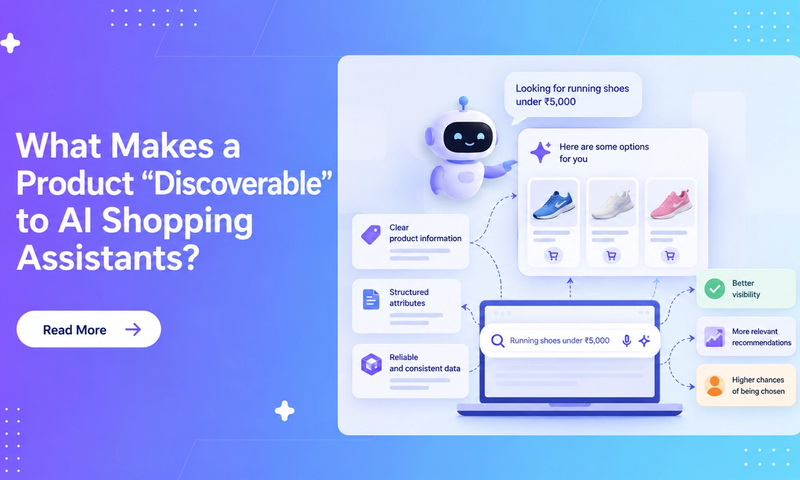
“What are comfortable running shoes under ₹5000 for daily training?”
AI systems respond with curated product suggestions — often without showing a traditional results page.
This introduces a major shift:
Your product page is no longer competing for rankings.
Your product data is competing for inclusion in AI answers.
From SEO to AEO: Answer Engine Optimization
The industry is moving toward what many call Answer Engine Optimization (AEO).
But for ecommerce brands, AEO depends almost entirely on one asset:
structured, enriched product data.
AI models rely on signals such as:
- product attributes
- taxonomy clarity
- contextual descriptions
- structured metadata
- semantic relationships between products
If product information lacks clarity, AI cannot confidently recommend it — regardless of brand size or advertising spend.
What Is Product Data Optimization?
Product Data Optimization is the process of structuring, enriching, and standardizing product information so AI systems can accurately understand, compare, and recommend products.
Unlike traditional SEO, this goes beyond titles and descriptions.
It includes:
Attribute Intelligence
Products must clearly communicate:
- material
- use case
- fit
- compatibility
- style
- performance characteristics
- audience intent
Example:
Weak Data
Men’s Shoes – Comfortable & Stylish
AI-Optimized Data
Men’s neutral running shoes with cushioned midsole, breathable mesh upper, suitable for daily training and long-distance runs.
The difference is not keyword density — it is semantic clarity.
Structured Product Taxonomy
AI models understand relationships between products.
Poor taxonomy breaks discoverability.
Common ecommerce issues:
- inconsistent categories
- duplicate attributes
- missing filters
- brand-specific naming conventions
- fragmented variant data
When taxonomy is standardized, AI systems can:
- compare alternatives
- generate recommendations
- power conversational discovery
This is where modern product discovery platforms like Wizzy become critical — connecting structured catalog intelligence directly to search experiences.

Contextual Product Descriptions (Not Marketing Copy)
Traditional ecommerce descriptions are written for persuasion.
AI search requires descriptions written for understanding.
High-performing AI-ready descriptions answer:
- Who is this product for?
- When should it be used?
- What problem does it solve?
- How is it different from alternatives?
Instead of promotional language:
Premium quality shirt crafted with excellence.
AI-ready content communicates usable knowledge:
Lightweight linen shirt designed for hot weather, offering breathable comfort for casual summer wear and travel.
AI rewards clarity over creativity.
The Hidden Problem: Most Ecommerce Catalogs Are Not AI-Readable
Many ecommerce brands assume their catalogs are optimized because products rank on Google.
However, AI discovery exposes structural weaknesses:
- incomplete attribute coverage
- inconsistent naming conventions
- missing intent signals
- shallow descriptions
- fragmented product relationships
- unstructured variant information
These gaps prevent AI systems from confidently recommending products.
As AI assistants increasingly become the first discovery touchpoint, poor product data directly translates into lost visibility.
How AI Systems Actually Evaluate Products
AI search engines and recommendation models evaluate products through layered understanding.
Semantic Matching
AI connects shopper intent to attributes, not keywords.
A product optimized only for “running shoes” may fail when intent becomes:
- marathon training
- plantar fasciitis support
- daily jogging comfort
Semantic richness determines inclusion.
Contextual Authority
AI prefers catalogs that demonstrate structured expertise.
Signals include:
- consistent attribute logic
- complete product coverage
- standardized schema
- strong internal relationships between products
Well-structured catalogs behave like authoritative knowledge bases.
Conversational Retrieval
AI search operates through dialogue.
Product data must support questions like:
- “Show alternatives”
- “Compare similar products”
- “What’s better for beginners?”
Without structured attributes and relationships, conversational discovery breaks.
Product Data Optimization Framework for Ecommerce Brands
1. Attribute Expansion
Move beyond basic attributes.
Add intent-driven fields such as:
- use occasion
- performance category
- skill level
- climate suitability
- compatibility
- lifestyle context
Attributes become AI understanding signals.
2. Standardized Naming Systems
Normalize:
- colors
- sizes
- materials
- styles
- variants
AI struggles when “navy,” “midnight blue,” and “dark blue” represent the same value without normalization.
3. AI-Readable Descriptions
Write descriptions using structured context:
- problem → solution → usage → differentiation
Avoid purely promotional copy.
4. Product Relationship Mapping
Define:
- alternatives
- complements
- upgrades
- bundles
- substitutes
AI recommendation engines rely heavily on relationship graphs.
5. Continuous Catalog Intelligence
Product data optimization is not a one-time SEO task.
Catalogs evolve constantly.
Leading ecommerce brands now treat product data as a living discovery layer, continuously optimized using behavioral and search insights.

Why Product Discovery Platforms Become Strategic in the AI Era
AI-ready catalogs require more than manual content updates.
Modern ecommerce growth depends on platforms capable of:
- understanding shopper intent in real time
- enriching discovery signals automatically
- structuring catalog intelligence dynamically
- learning from behavioral search patterns
Platforms like Wizzy enable this transition by transforming product catalogs into intelligent discovery systems rather than static databases.
The competitive advantage shifts from traffic acquisition to discoverability intelligence.
The Business Impact: From Traffic Optimization to Revenue Optimization
Traditional SEO optimized for clicks.
AI search optimizes for decisions.
Brands investing in product data optimization see measurable outcomes:
- higher product discoverability
- improved search-to-conversion rates
- stronger recommendation performance
- reduced zero-result searches
- better personalization outcomes
Visibility in AI environments increasingly determines revenue growth.
The Future of Ecommerce SEO
The next phase of ecommerce growth will not be won through more keywords or more content pages.
It will be won through better product understanding.
As AI becomes the primary interface between shoppers and catalogs:
- search becomes conversational
- discovery becomes predictive
- product data becomes the new ranking factor
Ecommerce SEO is evolving into AI discoverability optimization.
Brands that restructure their product data today will become the default answers tomorrow.
Conclusion
AI search is redefining how customers find products.
Success is no longer about optimizing pages for algorithms — it is about optimizing product knowledge for intelligence systems.
Product Data Optimization represents the foundation of the new SEO.
Ecommerce brands that invest in structured, enriched, and AI-readable catalogs will not just rank better; they will become discoverable wherever AI guides purchasing decisions.
And in the age of AI commerce, discoverability is growth.