What Does “Context” Actually Mean in Ecommerce Search?
Context in ecommerce search goes beyond matching keywords. Explore how shopper input, product and variant data, availability, and interaction signals influence search results and why facts, confirmed choices, and inferences should be treated differently.
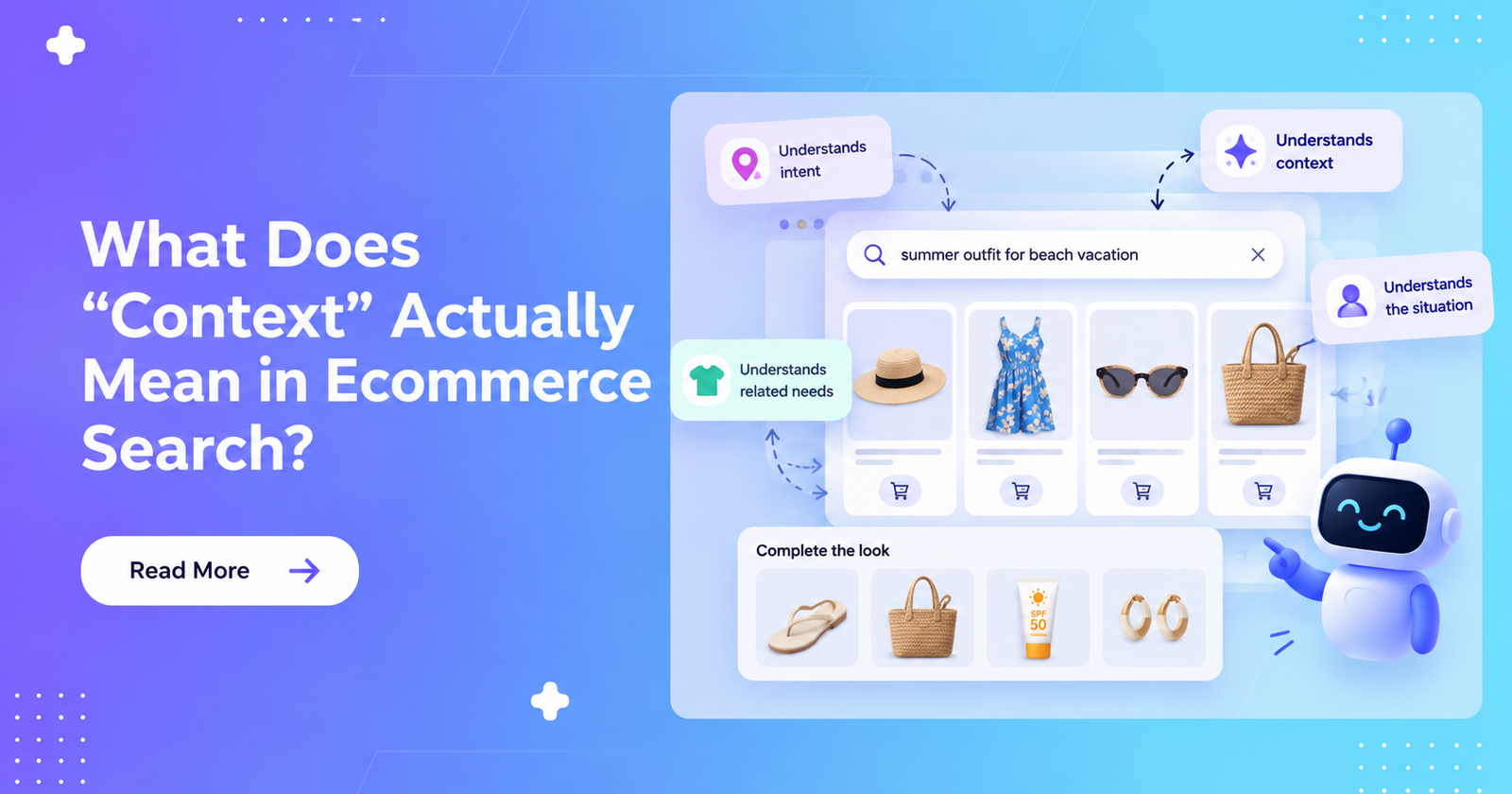
A shopper searches for a product, and the results contain the words they entered. But does that mean the results are relevant?
Not always.
A product might match the query but be available only in the wrong size. It may lack a required specification, be unavailable in the shopper’s market, or be similar to the requested item without being the exact product.
This is where context matters.
In ecommerce search, context is the information that helps determine whether a product matches a shopper’s needs, is eligible to appear, and deserves its position in the results.
It includes the shopper’s query, selected filters, product information, availability, and signals from previous interactions. Understanding how these signals differ can help ecommerce teams evaluate search relevance more effectively.
1. Context Is More Than Matching Keywords
Consider a shopper searching for “black running shoes, size 8, under ₹5,000.”
A product might match the words “black running shoes” but be available only in size 9. Another might meet the size requirement but exceed the budget. Both are related to the query, but neither fully meets the shopper’s requirements.
This highlights an important distinction: matching the search terms is not the same as satisfying the search intent.
A useful search experience needs to consider:
- What the shopper is looking for
- Which requirements they have explicitly stated
- Whether the relevant product or variant is available
- Whether the product is eligible to appear
- What additional signals can help distinguish between relevant options
Keyword matching, semantic retrieval, filters, and behavioural signals can all contribute to search. However, none automatically guarantees that the final result is correct.
The question is not simply whether a search system uses AI. It is whether the information influencing a result is appropriate for the decision being made.
2. Four Types of Context in Ecommerce Search
A practical way to understand context is to look at four types of evidence.
Shopper input
This includes the search query, selected filters, exact product identifiers, and answers the shopper confirms.
For example, if a shopper selects size M, that choice should not be silently replaced by a size inferred from their browsing history.
Shopify’s storefront search documentation and filtering documentation illustrate how search queries and applied filters can be handled separately.
Product and variant information
Product titles, descriptions, categories, specifications, sizes, and SKUs help establish whether an item meets the request.
However, information must be accurate, searchable, and associated with the correct product or variant.
For example, a laptop listing may mention 16 GB RAM, but the shopper needs to know whether that specification applies to the particular configuration being displayed.
Shopify’s ProductVariant documentation describes variant-specific information, including options, SKU, and availability-related details.
Availability and eligibility
A product may match the query but still be unavailable or ineligible under the current storefront rules.
Imagine a shopper searching for a dress in size M. The product exists, but that variant is out of stock.
Depending on the merchant’s policy, the product might be excluded, ranked lower, or shown with a clear availability label. What matters is that the results do not misrepresent whether the requested item can be purchased.
Relevance and availability answer different questions: one concerns how well the product matches; the other concerns whether it can appropriately be offered.
Interaction signals
Clicks, product views, purchases, and browsing history can help a search experience adapt to shoppers. But these signals require interpretation.
A click does not necessarily mean a shopper liked a product. They may have opened it to compare prices or discovered that it was unsuitable.
Similarly, a previous purchase may not reflect what the shopper wants today.
Interaction data can inform ranking or suggestions, but it should not automatically override clear requirements in the current query.
3. Explicit Context vs. Inferred Context
Not all context carries the same level of certainty.
Explicit context is information directly supplied or confirmed by the shopper, such as a selected size, price filter, exact model number, or answer to a clarification question.
Inferred context is a hypothesis based on observed behaviour or patterns, such as assuming a brand preference from repeated clicks or suggesting a category based on previous purchases.
Both can be useful, but they serve different purposes.
Suppose a shopper previously browsed children's shoes but now searches for “red shoes.” Their history may suggest a possible preference, but it does not prove that they are shopping for a child.
The search experience could offer a relevant refinement, but silently restricting results to children's shoes risks misunderstanding the current need.
The distinction changes when the shopper confirms a suggestion. If they explicitly select “children's shoes,” that choice becomes direct context for the current search.
Google Cloud documents one example of this approach in its conversational filtering documentation.
The practical lesson is simple: a signal can suggest what a shopper might want without proving what they currently need.
4. Why a Matching Product Can Still Be Wrong
Consider these hypothetical ecommerce searches:
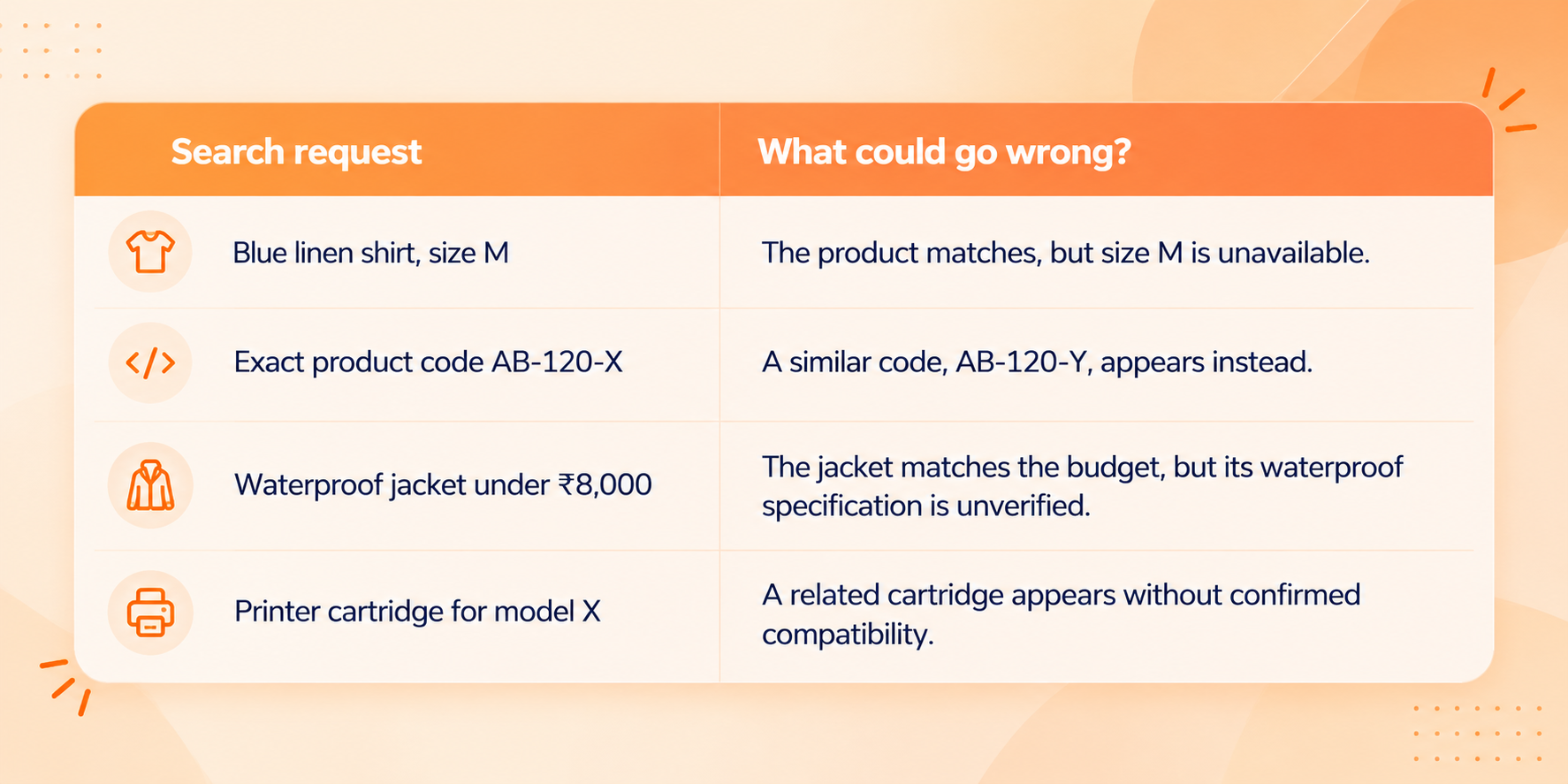
In each case, the product has some evidence in its favour. The problem is treating that evidence as sufficient.
A similar product code does not establish exact identity. A matching category does not establish compatibility. Missing information does not prove that a product meets a requirement.
This is why search reviews should distinguish between three states:
- Verified: The available evidence supports the requirement.
- Contradicted: The evidence shows that the requirement is not met.
- Unknown: There is not enough reliable information to decide.
Keeping these states separate helps prevent assumptions from being presented as facts.
5. How Ecommerce Teams Can Review Context
When search results seem irrelevant, changing ranking settings immediately may not address the real issue. The problem could lie in the query, product data, availability rules, or the interpretation of shopper behaviour.
Start by asking five questions:
- Where did the signal come from? Was it a query, filter, product field, availability rule, or interaction?
- Is it confirmed or inferred? Did the shopper explicitly choose it, or did the system assume it?
- What did it change? Did it affect which products appeared, their eligibility, or their ranking?
- Does stronger evidence contradict it? Check exact identifiers, selected attributes, variant details, and current availability.
- Has the result been tested in the real catalog? A general explanation cannot replace testing with actual products and storefront conditions.
These questions provide a practical starting point for investigating search relevance without assuming that one search method or ranking signal will solve every problem.
Conclusion
Context in ecommerce search is not simply another word for AI or personalization. It is the information used to understand what a shopper needs and determine whether a result genuinely fits that need.
Shopper input, product data, availability, and interaction signals each contribute different kinds of evidence. The challenge is knowing what each signal establishes and where its limitations begin.
A matching keyword is useful, but it is not the whole answer. A browsing pattern can suggest a preference, but it does not confirm one. A similar product may be relevant, but it is not necessarily the exact item requested.
For ecommerce teams, one question can make search reviews more meaningful:
What evidence changed this result, and was it a fact, a confirmed choice, or an inference?
That is a more useful starting point for evaluating search relevance than simply adding more signals.