B2B Ecommerce Search: A Practical Guide to Part Numbers, Product Attributes, and Compatibility
B2B ecommerce search goes beyond keywords. Learn how to handle technical attributes, part numbers, and compatibility with confidence.
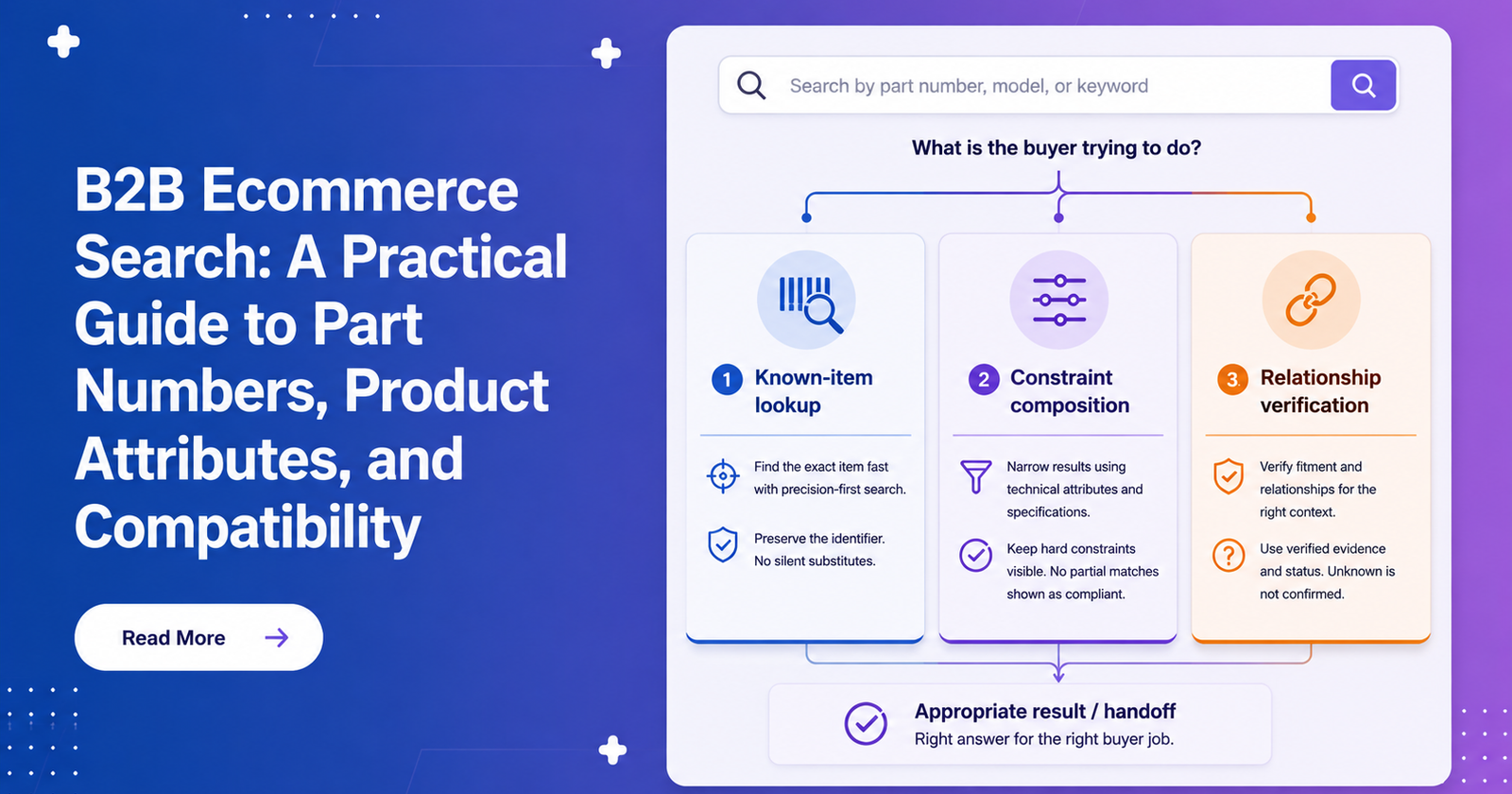
A technical catalog can place three very different buyer jobs behind one search box: locating a known item, narrowing products by several technical requirements, and checking whether an item works in a specific context. Treating all three as ordinary text matching can produce plausible-looking results that are still misleading.
This guide offers an original, practical framework for B2B commerce, distribution, catalog, and product leaders. It does not prescribe a universal architecture or describe a Wizzy capability. Instead, it asks teams to define the data, retrieval behavior, buyer handoff, and negative test appropriate to each request.
- Original conceptual diagram of the article’s three retrieval contracts.
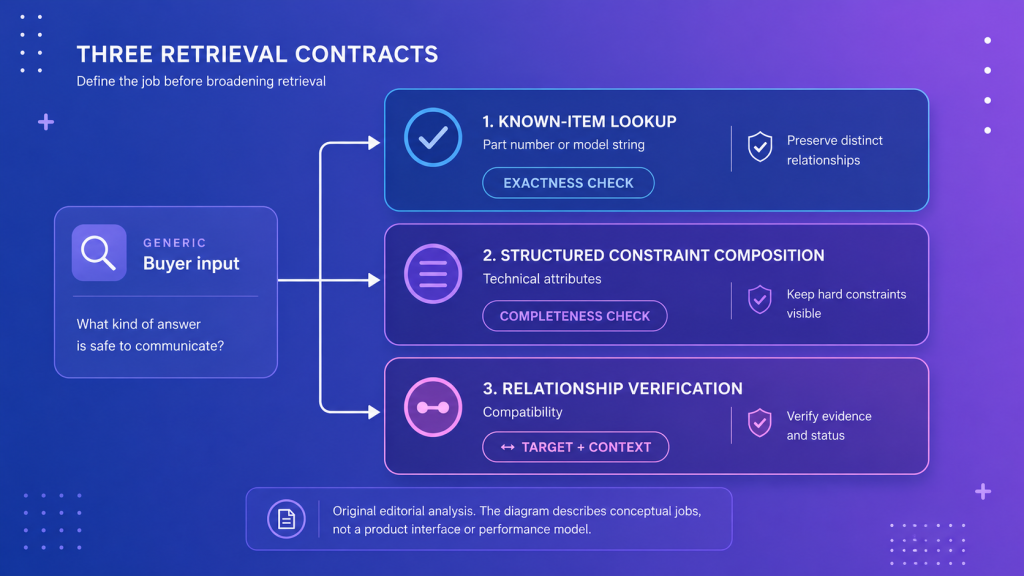
B2B ecommerce search is not one retrieval problem
Independent ecommerce UX research documents SKU or model-number lookups, feature queries containing product attributes, and compatibility-related queries. It also treats compatibility as a strict-compliance concern rather than a loose resemblance problem (Baymard Institute). That evidence does not show how prevalent these requests are in B2B. It does, however, support treating the input classes as meaningfully different.
The three contracts below are original editorial analysis, not an industry taxonomy or implementation schema.
| Buyer input | Data question | Retrieval and handoff | Required negative test |
|---|---|---|---|
| Part number or model string | Which identifier namespace is this, and is its original value retained? | Prefer a precision-first known-item route; label alternates, supersessions, and substitutes rather than treating them as the same item. | A one-character-near identifier does not silently return an unrelated product. |
| Attribute-heavy request | Are the category-specific attributes applicable, consistently populated, unit-aware, and available for the intended behavior? | Interpret product type and constraints; expose applied constraints and hand off to filters or a guided choice when needed. | A product that misses a required attribute is not presented as compliant. |
| Compatibility request | What is the target object, relationship, qualifier, evidence source, and status? | Verify an explicit relationship or ask for missing context; distinguish confirmed, conditional, incompatible, and unknown. | Similar names, categories, dimensions, or connectors are not treated as proof of compatibility. |
A single result set is therefore not a sufficient success signal. The team must decide what an answer is allowed to claim in each lane before broadening retrieval.
Readers who need the broader control-plane discussion can review query classification as a search-control problem. This guide stays focused on the data and safeguards required for the three concrete buyer inputs.
Part-number search is a known-item lookup with precision decisions
Start by identifying what the entered string represents. A catalog may contain an internal SKU, manufacturer part number (MPN), GTIN, customer number, supplier number, model ID, or legacy identifier. Google Merchant Center documentation distinguishes several of these product-data concepts, including GTINs, MPNs, item IDs, variants, and structured product details (Google Merchant Center). Schema.org likewise defines mpn specifically as a manufacturer part number (Schema.org). These vocabulary and feed examples do not determine a storefront’s search behavior, but they show why teams should not collapse all identifier-like values into one undifferentiated field.
A useful design question is: what should happen when the buyer enters an intact identifier, a differently formatted rendition of that identifier, or a genuinely changed string? Google’s AI Commerce Search documentation describes a product-specific exact-searchable setting for identifiers such as part numbers and SKUs, including the effects of text analysis on special characters (Google Cloud). Elasticsearch separately documents keyword fields for structured values and multi-fields for indexing one source value in more than one way (Elastic keyword fields; Elastic multi-fields). Those are platform examples, not defaults to copy.
Keep three choices separate:
- Exact lookup. Preserve the source identifier and give an intact, valid identifier a precision-first route.
- Formatting normalization. Decide whether a harmless presentation difference can be evaluated as a separate lookup form. For example, a hypothetical
AB-1200-Xand a punctuation-free rendition could be compared without asserting that either is a real catalog record. - Fuzzy recovery. Treat typo tolerance as an independently controlled, catalog-tested choice. Algolia documents configurable typo tolerance, illustrating that fuzzy behavior can be a deliberate mechanism rather than an automatic truth claim (Algolia).
A changed identifier is not the same as a formatting variant. Nor is an alternate, superseded item, or substitute the same as the exact candidate. Model those relationships explicitly where they exist, and label them in the experience. The key negative test is simple: a hypothetical one-character-near identifier must not silently resolve to an unrelated item. Whether and how to offer recovery depends on catalog evidence and the cost of a misleading match.
Attribute-heavy queries are a structured constraint-composition problem
Attribute-heavy requests often combine a product type with technical requirements, units, variant context, and preference language. Before expecting search to interpret that request, inspect whether the underlying attributes are usable: applicable to the category, consistently named, sufficiently populated, unit-normalized where relevant, and represented with the product or variant context the buyer needs.
A field appearing in a product record does not itself prove that it is searchable, facetable, filterable, retrievable, or ranked as intended. Google’s documentation explicitly distinguishes several of those behaviors in its product (Google Cloud). Merchant Center documentation also distinguishes variant-defining properties and name/value product details (Google Merchant Center). Each is a product-specific or feed-semantic example, not a guarantee about another catalog or search stack.
For a hypothetical request such as “stainless inline valve 1 inch high-pressure,” decide which terms name the product type, which describe hard constraints, which are preferences, and which remain unresolved. That interpretation is original operational guidance. A safe experience makes the interpreted constraints visible and adjustable. If the catalog needs a structured choice to determine a valid answer, hand the buyer to filters, a selector, or a clarification step rather than silently discarding a hard constraint to fill the page.
Test compliance rather than partial similarity. Include complete matches, products that meet only some hard constraints, missing required attributes, inconsistent units, and relevant variant-context cases. A result can be useful as a labelled alternative without being represented as a compliant answer to the original request.
Compatibility search is relationship verification, not similarity
Compatibility is the lane where a close-looking result can be especially misleading. Baymard’s research notes that compatibility queries may depend on the exact target model and that the expected behavior is strict compliance (Baymard Institute). This is broad ecommerce UX evidence, not a sector-specific safety or regulatory finding.
Before an experience asserts a match, establish the target object and any relevant qualifiers. Depending on the domain, those may include a model, variant, date range, region, configuration, connector, or another context value. Then ask what relationship is actually supported and what source or status establishes it.
Public data vocabulary and industry examples show that explicit relationships are possible in particular settings. Schema.org includes a property for associating an accessory or spare part with another product (Schema.org). The Auto Care Association describes ACES as an automotive-aftermarket fitment-data standard and PIES as a product-information standard (Auto Care Association). Neither provides a universal B2B compatibility schema; the automotive example should not be transferred to other domains without domain-specific evidence.
A practical compatibility record may therefore need a requested item, target context, qualifiers, relationship evidence, and a status. The proposed statuses—confirmed, conditional, explicitly incompatible, and unknown—are original analysis. The important experience rule is that unknown is not confirmed. When context is missing, route the buyer to a finder, selector, or clarification path. Do not infer compatibility from shared names, categories, dimensions, connector appearance, or keyword overlap.
Turn the three lanes into an evaluation and implementation backlog
Use representative requests rather than relying on whether a page returns anything. Elasticsearch documents rank evaluation with typical requests, supplied relevance ratings, and a defined metric (Elastic rank evaluation). Its API is an example, not required tooling or a universal test method.
The following matrix is original guidance for making the three contracts testable. It has no prescribed score, pass threshold, owner, or cadence.
| Lane and case | Expected state or handoff | What to inspect |
|---|---|---|
| Part number: exact hypothetical identifier | Exact candidate, if a valid record exists | Identifier namespace, source representation, and result label |
| Part number: formatting variant | Separately evaluated normalization path | Whether formatting changed only presentation, not the identifier itself |
| Part number: one-character-near value | No silent unrelated match | Recovery labels, ambiguity handling, and precision risk |
| Attributes: all required constraints | Candidate satisfies the stated hard constraints | Category applicability, units, variant context, and visible constraints |
| Attributes: partial or missing constraint | Not presented as compliant | Whether the experience exposes the gap or offers a clear revision path |
| Compatibility: complete target and evidence | Confirmed or conditional only when supported | Target, qualifiers, relationship source, and status |
| Compatibility: missing target or unknown relationship | Clarification, finder, or honest unknown state | Whether similarity was incorrectly treated as proof |
Translate each observed gap into a bounded item: name the lane, describe the data or relationship ambiguity, choose the retrieval or handoff behavior to evaluate, and define both a positive and a negative case. The appropriate participants may include catalog, search, product, commerce, or domain specialists. Review cadence should reflect catalog change, query volume, risk, and team capacity rather than a fixed schedule.
Use the right contract before expanding the result set
The practical sequence is deliberately conservative. A part number deserves a known-item precision decision. An attribute-heavy request deserves transparent constraint composition. A compatibility question deserves relationship verification in a defined context.
In each case, an expanded result set is not automatically a better answer. Review representative buyer requests with the people responsible for catalog data, product decisions, commerce experience, and search behavior. Keep exact matches, alternatives, incomplete context, and unknown states distinct. That is the foundation for an experience that remains useful without claiming more than the available evidence supports.
References and evidence boundaries
- Baymard Institute: Ecommerce Search Query Types — independent broad-ecommerce UX evidence for SKU/model, feature/attribute, and compatibility query behavior; not a B2B prevalence study or product-performance evidence.
- Google Cloud: Configure product attributes — product-specific examples of searchable, indexable/facetable, retrievable, exact-searchable, special-character, and variant-related behavior; not universal search defaults.
- Elastic: Keyword field type and multi-fields — product-specific mapping examples for structured values and multiple representations; not a recommended catalog configuration.
- Google Merchant Center: Product identifiers — feed-semantic examples for GTIN, MPN, item IDs, variants, and structured details; not storefront-search behavior.
- Schema.org: mpn and isAccessoryOrSparePartFor — public vocabulary examples, not validation or a complete compatibility policy.
- Auto Care Association: Data standards — an automotive-aftermarket example for ACES fitment and PIES product data; not a cross-industry schema.
- Algolia: Typo tolerance — product-specific evidence that typo behavior can be configured; not part-number guidance.
- Elastic: Rank evaluation — product-specific example of evaluating representative requests with supplied ratings; not a validated score or business-outcome measure.
The three-contract framework, the comparison and regression matrices, the proposed data questions, the buyer handoffs, and the suggested backlog are original editorial analysis. No evidence reviewed for this article establishes Wizzy capabilities, customer behavior, performance outcomes, conversion, revenue, procurement speed, market prevalence, or a universal architecture.