Image-to-Product Matching: How to Set Expectations for Variants, Similarity, and Availability
A non-numeric evaluation scorecard for separating visual resemblance from catalog identity, sellable-variant evidence, uncertainty, and availability. Visual similarity shows that a catalog candidate resembles an image. It does not, by itself, establish that the candidate is the same catalog item, th
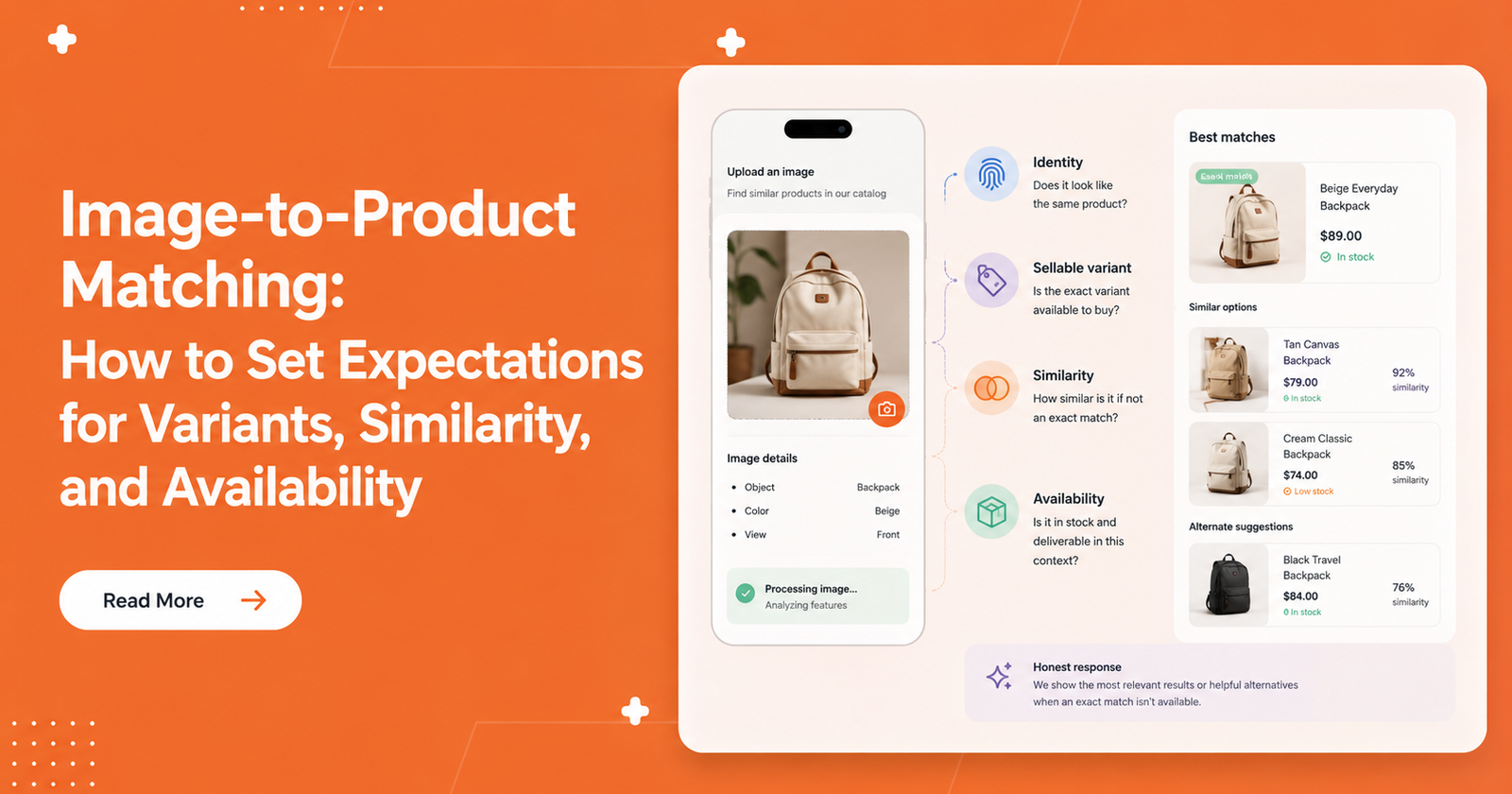
A non-numeric evaluation scorecard for separating visual resemblance from catalog identity, sellable-variant evidence, uncertainty, and availability.
Visual similarity shows that a catalog candidate resembles an image. It does not, by itself, establish that the candidate is the same catalog item, that the image represents a specific sellable variant, or that the resolved variant is available now. A buyer-facing response should keep those claims separate.
This article presents an original, non-numeric evaluation scorecard for retail, marketplace, and catalog teams. The framework, response states, wording rules, readiness questions, and test matrix are editorial analysis- not a standard, validated taxonomy, implementation schema, benchmark, certification, or system guarantee. They describe no Wizzy capability or product interface.
- Original editorial diagram of the four-evidence-check planning framework. It is not a real interface, result, benchmark, or system guarantee.
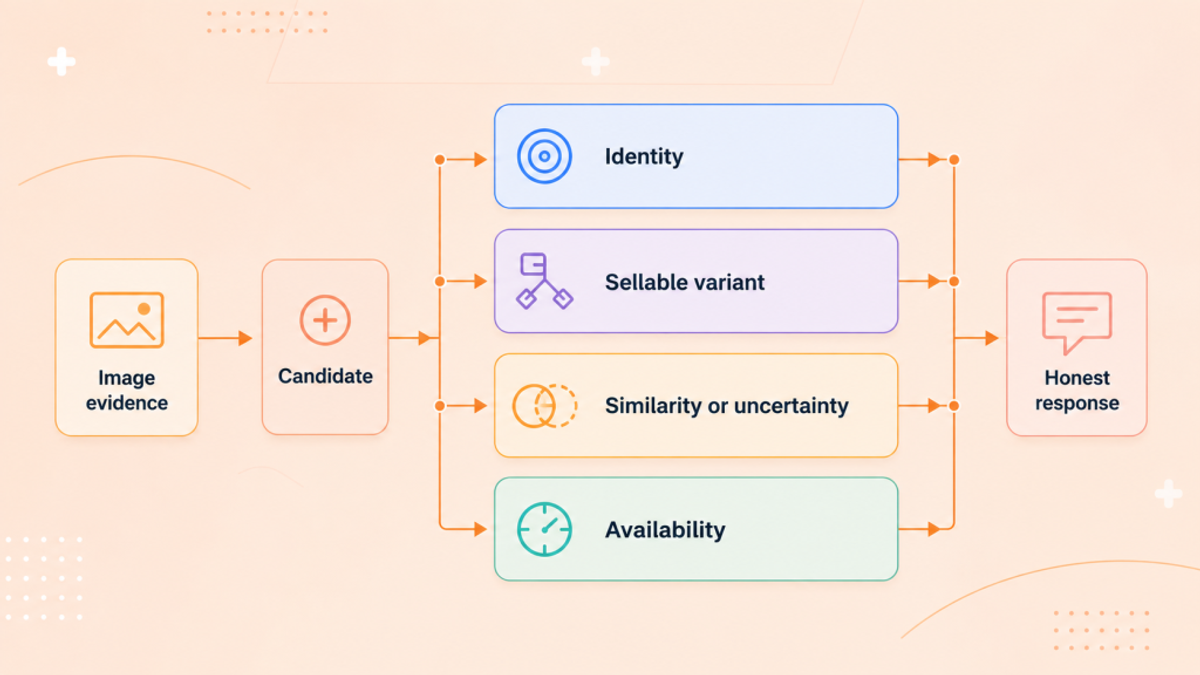
A visual match is not yet a buyer-safe product match
Google documents one maintenance-mode product-search system that returns ranked visually and semantically similar products. Its guidance also says its result scores are not calibrated across queries and that one fixed threshold does not suit every use case (Google Cloud Vision Product Search; general tips). This is a product-specific example, not a description of every visual-matching system.
Commerce and product-data documentation illustrates a different separation. Shopify models product variants with their own options, media, identifiers, inventory, and sale state (Shopify ProductVariant). Google Merchant Center distinguishes variant groups, variant-identifying properties, variant-appropriate images, and availability states (image requirements; product data specification). Schema.org distinguishes a product group from member variants that may be offered (Schema.org ProductGroup). These examples do not prescribe one catalog architecture, but they show why resemblance, product identity, variant identity, and availability should not be collapsed into one label.
Separate resemblance from the claims a result experience makes
Use the terms narrowly:
- A visually similar candidate is ranked or selected because it resembles the image; catalog identity is not yet established.
- Confirmed catalog identity means a verified association to the same stable catalog item, beyond resemblance or rank alone.
- A confirmed sellable variant is a specific variant record whose relevant attributes and media align with the item being offered.
- Availability is a separate commerce state for the resolved item or variant. It is not visible in the pixels and should not be inferred from a result’s presence.
Under this conservative editorial rule, “exact” is an identity claim. The highest-ranked or closest-looking candidate is not automatically exact. Confirmed identity also does not establish every visible or hidden variant fact, or whether the item can currently be purchased.
Use four evidence checks before one buyer-facing response
The following scorecard is original editorial analysis. It is a planning aid, not a universal standard, numeric model, maturity score, safety test, or guarantee that misleading responses will be prevented.
| Evidence check | Question | Minimum planning evidence | Safe wording consequence | Unsafe shortcut |
|---|---|---|---|---|
| Catalog identity | Is the input or candidate bound to a stable catalog record, or is it ranked only by resemblance? | A verified record association or explicit non-visual identity signal, with known provenance. | Use “same catalog item” only when identity is confirmed; otherwise use “visually similar.” | Calling the highest-ranked or closest-looking candidate exact. |
| Sellable variant | Which specific product version is represented and offered? | A variant ID, parent relationship, relevant option values, variant-appropriate media, and the applicable sale state. | Name only confirmed visible or recorded variant attributes and expose available choices separately. | Treating a parent product, pictured colour, or inferred size as the purchasable variant. |
| Similarity or uncertainty | What visual evidence supports the candidate, and where is it ambiguous? | Documented query conditions, candidate behavior tested for the category and use case, and an uncertainty or fallback rule. | Label resemblance as similarity; narrow the input, ask for a crop or choice, or report insufficient evidence when needed. | Using one universal threshold or promising a model explanation that the system does not provide. |
| Availability | Can the resolved item or variant be purchased now or under a stated future condition? | A sufficiently fresh state from the relevant commerce or inventory source at the same granularity as the offered variant. | State in-stock, out-of-stock, preorder or backorder, unavailable, discontinued, or unknown without changing match identity. | Inferring availability from the image, parent product, stale index, or presence in results. |
Score the response state without collapsing different kinds of evidence
The five response states below are original editorial analysis. They are buyer-facing planning states, not mutually exclusive database classes or a confidence ladder. A confirmed catalog identity may coexist with an unavailable resolved variant; the response should preserve both facts.
Confirmed catalog identity is not a variant or stock claim
Before using “same catalog item,” require a verified association to the same stable catalog record beyond a ranked candidate alone. Then continue to the specific variant and availability checks. Identity confirmation should not be stretched into a claim that every visible or hidden attribute matches.
Confirmed sellable variant requires aligned variant evidence
A variant-level claim needs a specific record, an explicit parent relationship, relevant option values, and media that represents the offered variant. Shopify documents a platform example in which variants can carry options, media, identifiers, inventory, and an availableForSale state. Merchant Center separately requires submitted images to show the correct variant and applicable visible details. Neither example proves that another experience uses those records correctly.
Visible colour, pattern, or material cues may help review a represented variant. Pixels alone do not prove size, fit, condition, authenticity, region, inventory, compatibility, or sellability. Even material should remain unconfirmed when it is not reliably visible or backed by the catalog record.
Label resemblance and insufficient evidence honestly
When identity is not established, “visually similar” is the narrower label. If the evidence is ambiguous, conflicting, multi-product, poorly cropped, out of scope, or unmapped, ask for a crop or selection, offer clearly labelled inspiration, or return an honest insufficient-evidence state. Do not invent an exact result or silently drop a visible constraint merely to return a candidate.
Join availability after the candidate and variant are resolved
Resolve availability at the same granularity as the offered variant. Keep the identity or similarity label intact when the sale state is in stock, out of stock, preorder or backorder, discontinued, unavailable, stale, or unknown. Platform field names and state semantics vary, and this framework prescribes no refresh interval or real-time guarantee.
Baymard’s UX research distinguishes temporarily out-of-stock products from truly unavailable products and discusses different next steps (Baymard Institute). Those next steps depend on merchant operations. The evidence does not show that every merchant can accept backorders or that one availability treatment is universally preferable.
Give each state a buyer-facing handoff
This response-state model is original editorial analysis, not validated copy, a legal policy, or a guarantee of buyer understanding.
| Response state | Minimum known evidence | Allowed wording or behavior | Handoff | Must not imply |
|---|---|---|---|---|
| Confirmed catalog identity | Verified association to the same stable catalog record, not resemblance alone. | State “same catalog item” narrowly. | Continue to variant and availability checks. | That every variant attribute matches or the item is available. |
| Confirmed sellable variant | A specific variant record with relevant attributes and media aligned; sale state checked separately. | Present the resolved variant and identify only the attributes that are confirmed. | Expose supported choices and the applicable availability state. | That pixels prove hidden facts, inventory, or sellability. |
| Visually similar candidate | Resemblance supports the candidate, but exact catalog identity is not established. | Say “visually similar” and expose confirmed differences or options when data supports them. | Let the buyer inspect, refine, or choose among clearly labelled candidates. | “Exact,” “same product,” “identical,” compatible, or guaranteed substitute. |
| Uncertain or insufficient evidence | Evidence is ambiguous, conflicting, multi-product, out of scope, or lacks a safe mapping. | State that the item cannot be confirmed from the available evidence. | Ask for a crop or selection, or offer clearly labelled inspiration. | A fabricated exact result or a silently removed constraint. |
| Unavailable or out-of-stock | Identity or similarity may be known; the resolved item or variant has a non-purchasable, future, stale, or unknown sale state. | Preserve the match label and state availability separately. | Offer only merchant-supported next steps or clearly labelled similar alternatives. | That an alternative is the exact item or all variants share one stock state. |
Check whether catalog and image evidence can support the response
The readiness questions in this section are original editorial recommendations. They help a team inspect its own evidence; they do not require a particular schema, service, field name, or owner.
Trace identity and relationships to stable records
Ask:
- Are product and variant identifiers stable, distinct, and traceable to their source?
- Is the parent or product-group relationship separate from each sellable variant?
- Can each media record be traced to the product and, where relevant, the exact variant?
- Are similar alternatives explicitly typed as alternatives rather than identities?
Schema.org’s ProductGroup vocabulary and the Shopify variant model illustrate parent-member and product-version distinctions. They are not complete commerce schemas or proof that a storefront resolves the distinction correctly.
Audit whether the image represents the relevant visible variant
Merchant Center’s listing guidance says an image should represent the correct variant and its applicable visible details, such as colour, pattern, and material. Google’s Product Search documentation separately describes product-linked reference images and recommends clear product-focused images with relevant viewpoints (reference images). These are product and feed examples, not universal image-quality benchmarks or proof of visual-search accuracy.
For the intended category and task, ask whether important visible variants have clear, variant-appropriate media; whether useful viewpoints exist; and how the experience handles placeholders, generic illustrations, lifestyle ambiguity, occlusion, and multi-product scenes. Multiple viewpoints are a planning question, not a universal production minimum.
Separate visible attributes from non-visible facts
Use consistent catalog values for relevant attributes and create a review path for disagreements among the image, variant record, and listing content. Keep facts unconfirmed when they are not visible or otherwise supplied by a reliable record or user context. An image that looks close is not evidence of size, fit, compatibility, authenticity, condition, region, inventory, or current availability.
Baymard’s older research on text colour searches supports showing the variation relevant to a request so a shopper can see why a result is relevant (variation searches). It is not image-upload research, and its findings do not establish a current visual-matching benchmark. Its research on grouping variations also supports making available variations discoverable without prescribing one data model (combining variations).
Make variant-level availability and freshness visible
Ask which commerce or inventory source is authoritative for the resolved variant, what freshness information the response can expose, and what happens when the state is stale or unknown. Distinguish in-stock, out-of-stock, preorder or backorder, discontinued, unavailable, and unknown only where the merchant’s source supports those meanings. Do not apply a parent product’s state to every variant or infer stock from image evidence.
Design response language and handoffs for uncertainty, not just successful candidates
Response wording should be no broader than the evidence behind it. The wording rules below are original editorial analysis and generic copy patterns. They are not validated language, a universal UX pattern, or legal guidance.
Reserve “exact” and “same catalog item” for confirmed identity
| Evidence state | Allowed narrow wording | Next check or handoff | Wording to avoid |
|---|---|---|---|
| Verified catalog identity only | “Same catalog item.” | Resolve the represented sellable variant and its availability. | “Exact available variant” or any claim that all attributes match. |
| Verified identity and aligned variant evidence | “Same catalog item; the represented variant attributes are confirmed in the catalog.” | State only the confirmed attributes, then expose the applicable sale state. | Claims that the image proves size, fit, authenticity, inventory, or another hidden fact. |
| Resemblance without verified identity | “Visually similar.” | Expose confirmed differences or options and let the buyer refine or choose. | “Exact,” “identical,” “same product,” or “guaranteed substitute.” |
| Ambiguous or conflicting evidence | “We can’t confirm the item from the available image evidence.” | Ask for a crop or selection, or offer clearly labelled inspiration. | A confident match label or an unexplained removal of constraints. |
| Resolved item with known sale condition | Preserve the identity or similarity label, then state the supported sale condition separately. | Offer only actions supported by the merchant’s operations. | Language that changes match identity because stock changed. |
| Unknown or stale availability | “Availability is not confirmed.” | Refresh or verify the resolved variant’s state before making a current claim. | “In stock” based on an image, parent record, stale index, or result presence. |
| Exact item unavailable; similar candidate available | “Same catalog item unavailable; visually similar alternative.” | Keep the exact item and alternative visibly distinct. | Presenting the alternative as the exact unavailable item. |
Make the next action match the evidence gap
A similarity-only result needs inspection or refinement, not an exactness claim. Ambiguous image evidence may need a crop, product selection, or an honest stop. An unavailable resolved variant may lead to a merchant-supported notification, preorder, or alternative path—but only when that operation exists, and without changing the match label.
Assign questions to the appropriate review conversation
Use ownership questions rather than assuming one org chart:
- Who verifies that an image or candidate is bound to the stated catalog item?
- Who resolves disagreement among media, visible attributes, variant records, and listing content?
- Which commerce or inventory source owns the current state at variant level?
- Who approves buyer-facing language for ambiguity, unavailable items, and alternatives?
The right participants and workflow vary by organization. This article prescribes no service boundary, SLA, refresh interval, test cadence, or release gate.
Test the response contract with the cases that expose false exactness
A result appearing is not a pass criterion. Review identity, sellable variant, similarity label, availability, and buyer-facing response separately. The matrix below is an original, non-exhaustive editorial test set. It contains no observed results, real catalog or query data, numeric target, universal pass threshold, validation claim, or launch decision.
Build the scorecard around evidence, response, and a human review question
| Test condition | Expected evidence state | Permitted response label | Availability expectation | Prohibited implication | Reviewer note |
|---|---|---|---|---|---|
| Positive: catalog asset with verified binding | Catalog identity confirmed; variant still assessed separately. | Same catalog item. | Check the resolved variant; do not infer stock. | Every attribute and sale state are confirmed. | Verify binding provenance and label scope. |
| Positive: alternative view of the same bound item | Identity may be confirmed through the verified binding, not viewpoint resemblance alone. | Same catalog item, if the binding remains valid. | Resolve the represented variant independently. | Any alternative view proves a specific variant. | Check that viewpoint coverage does not cross item or variant boundaries. |
| Positive: visible variant aligned with media and record | Specific variant and relevant visible attributes confirmed. | Confirmed variant, naming only supported attributes. | Join the same variant’s current state. | Hidden attributes or availability follow from pixels. | Compare media, option values, and parent relation. |
| Positive: resolved variant with supported in-stock state | Identity, variant, and current sale state separately supported. | Identity or similarity label plus the supported availability state. | Use the authoritative source and applicable freshness policy. | All variants are in stock. | Record source, granularity, and freshness evidence. |
| Negative: visually similar but different catalog item | Similarity supported; identity not confirmed. | Visually similar. | State availability only for the candidate’s resolved variant. | Exact, same product, or guaranteed substitute. | Confirm that rank or resemblance did not become identity. |
| Variant: near-duplicate colour, pattern, or material | Parent or similarity may be known; exact variant is unresolved or different. | Similar variant or insufficient evidence, as supported. | Do not borrow stock from the near duplicate. | The pictured and offered variants are identical. | Inspect distinguishing media and variant values. |
| Variant: parent match with unresolved sellable variant | Parent identity may be known; purchasable version is not. | Same product group or catalog item only if that identity is verified. | Unknown until a variant is resolved. | The parent is a specific available variant. | Require a variant choice or honest unresolved state. |
| Variant: represented size or other hidden fact is missing | Visible evidence cannot establish the missing fact. | Do not confirm the hidden attribute. | Check only after a specific variant is supplied or selected. | The image proves size, fit, condition, or inventory. | Check whether catalog or user context can supply the fact. |
| Ambiguity: multi-product image | Target object is ambiguous. | Insufficient evidence until the buyer selects or crops. | No availability claim before resolution. | An arbitrary object is the intended exact item. | Test selection and crop handoffs. |
| Ambiguity: poor crop or occlusion | Evidence is incomplete or weak for the intended decision. | Insufficient evidence or clearly labelled inspiration. | No availability claim before a safe mapping. | A high rank compensates for missing visual evidence. | Check whether the response asks for a more useful image. |
| Ambiguity: placeholder, generic illustration, or lifestyle scene | Media may not represent one sellable item or variant. | Insufficient evidence unless another verified association exists. | Unknown until a catalog item and variant are resolved. | The pictured scene or placeholder establishes identity. | Confirm the explicit handling rule for non-product-focused media. |
| Negative: no safe candidate or out-of-scope image | No evidence supports a catalog identity or useful similarity claim. | No confirmed match; optional inspiration only if clearly labelled. | No availability claim. | A fabricated result or silently broadened intent. | Verify the honest no-result or fallback behavior. |
| Availability: confirmed item or variant is out of stock | Match identity and out-of-stock state coexist. | Preserve the match label; state out of stock separately. | Use the resolved variant’s state. | A similar in-stock item is the exact match. | Inspect separation of identity, stock, and alternatives. |
| Availability: preorder or backorder | Future-condition state is supported by the merchant source. | Preserve the match label and use the merchant-supported condition. | Do not promise timing or ordering unless supported. | Currently in stock or universally orderable. | Confirm the operation and wording exist for this merchant. |
| Availability: discontinued or otherwise unavailable | Identity may be confirmed; current offer is unavailable. | Preserve identity and state unavailable or discontinued as supported. | Offer alternatives only as alternatives. | The replacement is the same item. | Check whether permanent and temporary states remain distinct. |
| Availability: state unknown | Identity or variant may be known; sale state is not. | Availability not confirmed. | Verify before making a current claim. | Presence in results means purchasable. | Confirm that unknown is visible rather than defaulted to available. |
| Stale data: variant availability is older than the accepted policy | Identity may be known; availability evidence is stale. | Preserve match label; mark availability unconfirmed or stale. | Refresh from the relevant source. | The old state is current. | Check source timestamp or freshness signal without prescribing an interval. |
| Stale data: media-to-variant mapping is outdated | Item or parent may be known; represented variant is unreliable. | Do not confirm the variant from the stale mapping. | Resolve only after the mapping is corrected or independently verified. | The old image still represents the offered variant. | Compare current media association and variant record. |
| Missing data: no media-to-record mapping | Visual resemblance may exist; identity is unverified. | Visually similar or insufficient evidence. | No item-level availability join without a safe mapping. | The top candidate is exact. | Identify the missing association as the next evidence gap. |
| Missing data: no variant-level availability | Item or variant identity may be known; sale state has insufficient granularity. | Preserve identity; availability not confirmed for the variant. | Do not inherit the parent state. | All variants share the parent product’s availability. | Route the granularity gap to the relevant commerce-data review. |
| Conflicting data: image, variant record, and listing disagree | Evidence conflicts; exact variant claim is unsafe. | Insufficient evidence pending review, or a narrower confirmed identity label. | Do not present a current variant sale state until resolved. | One source silently overrides the others without review. | Verify disagreement detection and a bounded correction path. |
Use the observed gap to decide what can be claimed now
For each case, choose the narrowest supported outcome: retain a limited response label, change the wording or handoff, correct a catalog/media/availability gap, or mark the case insufficient for the intended experience. The matrix does not certify a model or release and is not complete for every category, customer, or commerce operation.
Choose the narrowest honest label before expanding the experience
Resemblance, catalog identity, sellable variant, and availability are separate facts. A team should claim only what its current image, catalog, variant, and commerce evidence supports, then fix the smallest evidence gap that prevents a more specific label.
Review representative category cases with the catalog, merchandising, commerce or inventory, and product or search stakeholders appropriate to the organization. Keep exact identity, variant confirmation, visually similar alternatives, unknown evidence, and availability conditions distinct. This scorecard is a planning aid, not an endorsement of a vendor, a description of a Wizzy system, or proof of accuracy, buyer outcomes, conversion, revenue, or other commercial impact.
Evidence boundaries to retain
- Google’s Product Search documentation is a maintenance-mode, product-specific example of ranked visual and semantic similarity, product-linked reference images, and query-relative score limitations. It does not establish universal system behavior.
- Shopify and Merchant Center document platform and feed concepts; Schema.org is a vocabulary. Their records do not prove a visual-matching implementation or prescribe one architecture.
- Baymard provides bounded UX evidence about relevant variation presentation and availability situations. Its older colour-query research is not image-upload testing, and no benchmark or percentage from it is used here.
- No article-specific query logs, catalog extract, inventory feed, model evaluation, user study, analytics, or approved current Wizzy product evidence was supplied.
The four-check scorecard, five response states, compound-state rule, wording rules, readiness questions, ownership questions, and test matrix remain original editorial analysis. They are not universal standards, validated copy, performance evidence, or system guarantees.